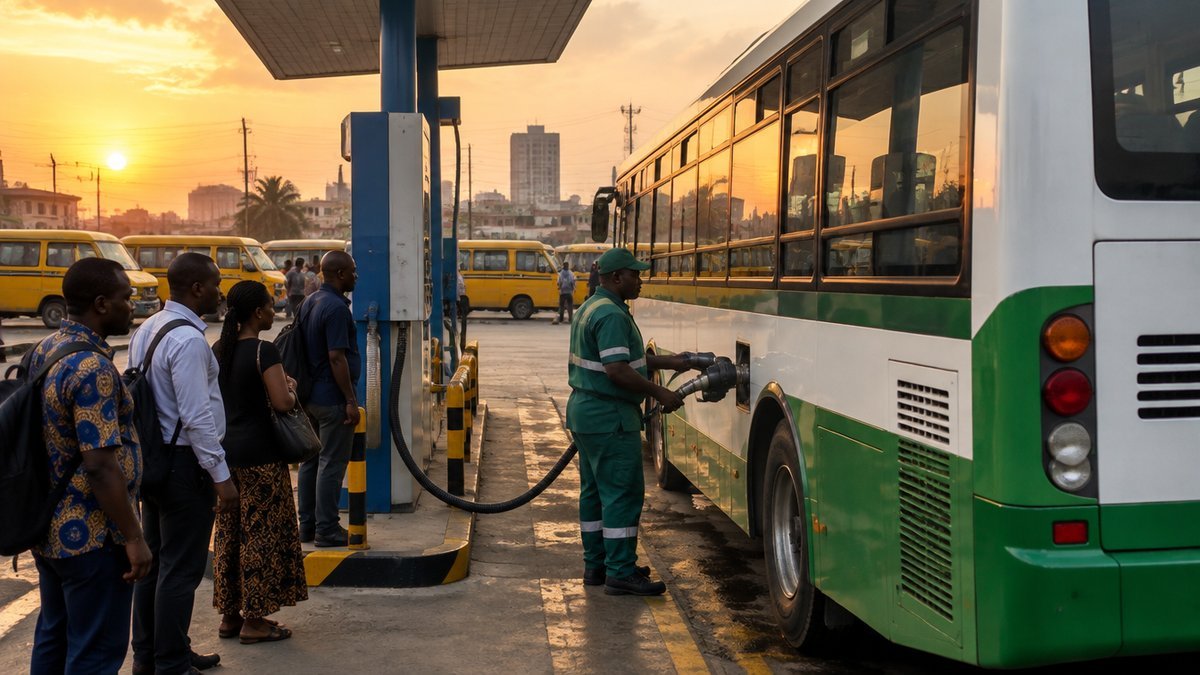
From tomorrow, October 1, 2026, the Federal Government wants Nigerians to start feeling cheaper transport fares. The vehicle for that promise is compressed natural gas (CNG). Under the new National Affordable CNG Transit Programme, states are putting CNG buses on the road, union drivers are being pushed to convert, and the Presidency is expecting fares to come down.
Will your bus fare to work actually drop? Should you convert your car or keke to CNG now? This explainer covers what has been announced, what it costs, which states are ready and which are not, and the problems still facing CNG users in Lagos, Abuja and beyond.
What Is the National Affordable CNG Transit Programme?
According to a September 19, 2026 statement from President Bola Tinubu, he met the governors of all 36 states on August 27 and they agreed that “from October 1, more Nigerians should begin to see measurable reductions in transportation costs.” An implementation committee was set up under the Nigeria Governors’ Forum, chaired by Kwara State Governor AbdulRahman AbdulRazaq. It works with the Presidential Initiative on CNG and Electric Vehicles (Pi-CNG & EV), state governments and transport unions.
The Presidency linked the push to the current global energy crisis, which it said is putting pressure on petrol and diesel prices around the world. It also ruled out bringing back the petrol subsidy. The plan is to move more commercial transport onto gas, which Nigeria produces locally, and make sure the savings reach passengers.
The headline numbers
According to the Presidency’s September update:
- More than 120,000 vehicles have been converted to CNG nationwide.
- Over 400 certified conversion centres are operating.
- More than 90 CNG refuelling stations are open. Earlier government figures put these in 23 states.
- Separately, NADDC’s Director-General said in late August that 81 companies are now licensed to retail CNG, up from about four before.
Fare Cuts Already Recorded: State by State
The Presidency listed several routes where CNG or electric buses are already cheaper than regular commercial fares. These are official figures and mostly apply to government-backed services, not every bus on the road:
- Abuja (NURTW partnership): 40% off on CNG-converted commercial vehicles on some routes. Area 1 to Gwagwalada fell from ₦1,500 to ₦900, Nyanya from ₦700 to ₦420, and Wuse from ₦400 to ₦240.
- Oyo (Pacesetter Transport): Lagos–Ibadan fell from about ₦8,000 to ₦3,200 during the first deployment.
- Enugu: 100 CNG buses deployed. Enugu–Nsukka fell from ₦2,500 to ₦1,500.
- Kaduna: 100 CNG buses donated for free rides. The state says about 3.2 million passengers have used them, saving an estimated ₦3.5 billion in fares.
- Borno: CNG and electric services charge ₦50–₦100 on routes where commercial operators charge ₦300–₦600.
- Plateau: about 13,000 commuters a day at ₦200, against more than ₦500 commercially.
- Adamawa: some fares cut by up to 50%, from ₦8,000 to ₦4,000.
- Niger: Suleja–Abuja at ₦550 instead of about ₦800.
- Abia: the Green Shuttle charges ₦2,000 for Umuahia–Arochukwu, while private operators charge ₦5,000. The state plans to grow the fleet to 100 buses.
Who is ready, and who is not
Reports from across the states published on September 27 suggest that not every state will be ready for October 1:
- Deployed or deploying: Kano (222 CNG and electric vehicles launched in May, plus more than 1,000 commercial vehicles converted), Akwa Ibom (50 buses), Cross River (10 buses), Abia and Kaduna.
- Waiting for buses: Edo plans to unveil 50 buses on October 15. Delta is waiting for 50 buses while it finishes terminals in Asaba and Warri. Ondo has asked the Federal Government for 100 CNG buses and 100 CNG tricycles.
- Still planning: Lagos says it is still in talks with the Federal Government. Ogun, Osun, Anambra, Imo and Ebonyi have announced plans or blueprints but no firm fare cuts yet.
Bottom line for commuters: if you live on a route that already has state-run CNG buses or NURTW-backed converted vehicles, you may pay less from October. Everywhere else, expect a slow rollout, not an overnight nationwide fare cut.
How Much Does CNG Cost Compared With Petrol?
In late August 2026, NADDC’s Director-General gave the official CNG pump prices:
- ₦380 per standard cubic metre (SCM) for cars and passenger buses
- ₦450 per SCM for heavy-duty vehicles and lorries
Real pump prices vary by city and station. Drivers interviewed by Nairametrics in August reported paying around ₦400/SCM at some Abuja stations. A station manager on the Keffi–Abuja road quoted ₦200–₦250/SCM at the time. Treat ₦380 as a guide, not a guaranteed price.
Petrol, by contrast, sells in the four-figure range per litre. See our recent breakdown, Petrol at ₦1,385: What It Now Costs to Run Your Car. As a rough rule of thumb, one SCM of CNG gives a similar amount of driving to one litre of petrol. The exact figure depends on the vehicle and the conversion kit. On that rough basis, CNG costs less than a third of petrol per kilometre.
Savings users are reporting
- An Abuja taxi driver told Nairametrics that about ₦5,000 worth of CNG lets him work for two days.
- An Abuja public servant said his weekly commuting fuel bill fell from ₦50,000–₦60,000 to about ₦15,000.
- NADDC’s DG cited a motorist on a Jigawa–Kano trip whose fuel cost fell from over ₦200,000 to about ₦40,000 after switching to CNG in Kano.
CNG Conversion Cost in Nigeria (2026)
Conversion is the biggest upfront cost. Figures vary with the vehicle, the kit, the cylinder size and whether you qualify for a subsidy:
- Small cars and sedans (e.g. Corolla, Camry class): roughly ₦350,000–₦600,000, according to 2026 market estimates
- Larger SUVs and minibuses: roughly ₦500,000–₦900,000
- Heavy buses and trucks: roughly ₦1 million–₦1.7 million
- Real-world example: two Abuja commercial drivers told Nairametrics they each paid ₦650,000 to convert
These are estimates. Always get a written quote from a certified conversion centre before paying. Pi-CNG has run subsidised and free conversion schemes for eligible commercial vehicles and union members, often through transport unions. In May 2025 it also launched a ₦2.5 billion credit scheme to help fund conversions. Ask your union branch or a Pi-CNG-accredited centre whether you qualify before paying full price.
The Problems Nobody Should Ignore
CNG is cheap per kilometre, but a Nairametrics investigation published on September 20 found many users struggling. The main issues:
- Queues and scarcity. Abuja drivers described waiting four to six hours for gas at busy stations, and some sleep at the station overnight. One driver called the roughly 10 CNG stations serving Abuja “grossly inadequate”. Time spent in a queue is time you cannot earn money carrying passengers.
- People switching back to petrol. Some keke and car owners in Lugbe and elsewhere in Abuja have gone back to petrol because they cannot reliably get gas.
- Loan repayment risk. Operators who borrowed to convert say they cannot plan repayments when gas supply is unpredictable.
- Safety fears. A reported cylinder explosion during refuelling in Abuja has led to warnings against unauthorised cylinders and parts. Use only accredited centres and certified kits.
- Maintenance. One user said his spark plugs need changing about every two months to avoid breakdowns. Budget for more frequent servicing.
- Long trips. Station coverage is still thin between cities, so many drivers keep petrol as a backup for long journeys.
- Operators keeping the savings. Commuters told Nairametrics in August that fares had not fallen even as drivers paid less for fuel. NADDC’s DG has also said some operators refuse to pass the savings on, and that tackling this is “the next stage”.
There is some progress on skills. NADDC has begun validating national training manuals to standardise how technicians are trained and certified to install and service CNG and EV systems. This should improve conversion quality over time.
Should You Convert Your Car or Keke to CNG Now?
It depends on where and how you drive.
Conversion makes more sense if you:
- Drive commercially (taxi, ride-hailing, keke, minibus) and cover long daily distances
- Have a reliable CNG station on or near your regular route. Check how long the queues are at peak times before you commit.
- Qualify for a subsidised or free conversion through Pi-CNG or your union
- Plan to keep the vehicle for several years, so the savings pay back the conversion cost
Wait if you:
- Drive a private car for short, occasional trips. The payback period could be long.
- Live in a state with few or no working CNG stations yet
- Travel often between cities on routes without CNG coverage
- Would have to take an expensive loan to convert
A simple payback check: divide the conversion cost by your realistic monthly fuel saving, after allowing for extra maintenance and any time lost in queues. If the answer is more than two years, the case gets weaker, especially for private cars. Remember that conversion may also affect your warranty and car insurance. Tell your insurer, and keep your certified installation documents.
FAQ: CNG Fare Cuts and Conversion in Nigeria
Will all transport fares fall on October 1?
No. The October 1 target applies to routes where states, Pi-CNG and unions have put CNG or electric vehicles in service. Several states, including Lagos, have not announced specific fare cuts yet.
What is the official CNG price in Nigeria?
₦380 per SCM for cars and passenger buses and ₦450 per SCM for heavy vehicles, according to NADDC in August 2026. Actual prices vary by station.
How much is CNG conversion?
Market estimates range from about ₦350,000 for small cars to over ₦1 million for heavy vehicles. Subsidised or free options exist for some eligible commercial operators.
Is CNG safe?
Properly installed systems with certified cylinders are designed to handle high-pressure gas. Most risk comes from unaccredited workshops and substandard parts, so use certified conversion centres only.
Key takeaway: The CNG transit programme is already cutting fares on some routes, and CNG is much cheaper per kilometre than petrol. Station access, queues and conversion costs are still the biggest obstacles. Commuters should look for government-backed CNG routes in their state. Drivers should check refuelling access and subsidy eligibility before paying for a conversion.
Vehicle prices, import duties, fuel prices and specs change frequently in Nigeria. Always confirm current figures with the dealer, conversion centre or official source before buying.
Information in this article is based on statements from the Presidency (September 2026), NADDC, and reporting by Nairametrics, Legit.ng and The Nation.