Buying a new car in Nigeria is one of the biggest purchases most families or small businesses will ever make, often paid for with years of savings, a bank car loan or business capital. But the real cost of ownership does not end at the showroom. If your car develops a fault and you cannot find genuine spare parts, a trained technician or a dealer willing to honour the warranty, that “affordable” car quickly becomes expensive.
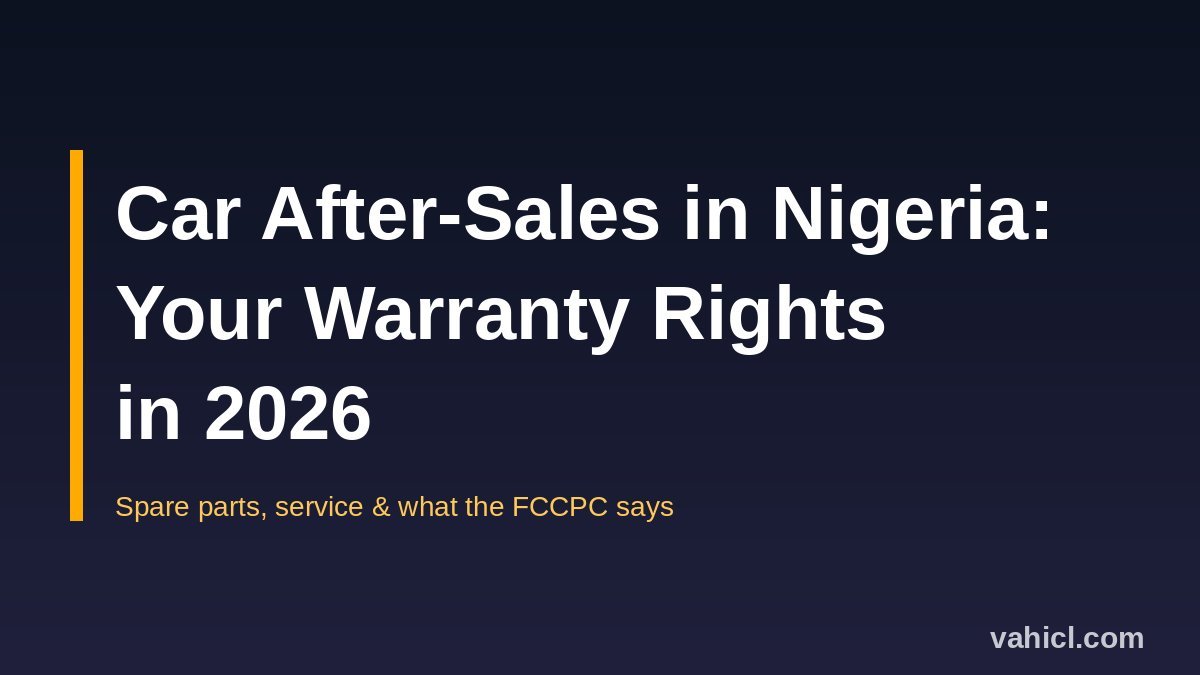
That problem is now firmly in the spotlight. In a November 16, 2026 report, BusinessDay said carmakers in Nigeria face growing pressure to improve after-sales support, with buyers pushing for better warranty protection, access to genuine spare parts and faster repairs. The same week, at the 26th Abuja International Motor Fair, the National Automotive Design and Development Council (NADDC) said it has agreed with local assemblers to set up after-sales service workshops nationwide. And the Federal Competition and Consumer Protection Commission (FCCPC) has been reminding businesses that a consumer’s right to repair, replacement or refund is backed by law.
Here is what that means for you as a car buyer in Lagos, Abuja, Port Harcourt or anywhere else in Nigeria, and how to protect yourself before you sign.
Why Car After-Sales Has Become a Big Issue in Nigeria
The Nigerian new-car market has changed fast. Alongside long-established Japanese and Korean brands, buyers now see a wave of newer brands, many of them Chinese, plus locally assembled vehicles and a growing number of hybrids and EVs. Each brings different technology, different parts and different diagnostic tools.
According to BusinessDay’s reporting, mechanics say getting parts for vehicles from newer brands entering Nigeria is difficult. One mechanic quoted in the report put it simply: the challenge mechanics have is the difficulty of getting car parts. When parts are scarce, repairs take longer, cost more, and some owners end up with cars parked for weeks.
We have covered this from the mechanic’s side before in our look at whether local workshops can fix Chinese cars. The difference now is that regulators and the auto council are publicly treating after-sales as a policy issue, not just a customer service problem.
What the FCCPC Says About Your Rights as a Car Buyer
The FCCPC’s message, repeated at stakeholder engagements held with the Lagos State Consumer Protection Agency (LASCOPA), is that consumer protection rules are legal obligations, not optional good practice. Speaking through officials at those engagements, FCCPC Executive Vice Chairman and CEO Tunji Bello made several points that apply directly to car buyers:
- Implied warranty of quality: every transaction carries an implied warranty that goods are of acceptable quality and fit for the purpose for which they were bought. BusinessDay notes this sits in the Federal Competition and Consumer Protection Act (FCCPA) 2018, with Section 132 covering the implied warranty of quality and remedies for defective products.
- Repair, replacement or refund: consumers are entitled to remedies when goods fail legally required standards, and Bello said the right to a refund, replacement or repair “will be respected” where the law provides for it.
- “No refund” notices don’t override the law: at a July 2026 meeting in Lagos, the FCCPC said businesses cannot rely on notices such as “no refund after payment” where the law gives a remedy, because such notices cannot take away rights guaranteed by law.
- Disclosure of used or reconditioned goods: the FCCPC also said businesses must disclose when products are reconditioned or second-hand, which matters for anyone buying “nearly new” or demo cars.
- Restrictive company policies: the Commission has warned businesses against using restrictive in-house policies to dodge their legal obligations to customers.
For car buyers, the practical takeaway is that manufacturers, distributors and dealers are expected to honour applicable warranty obligations and provide remedies when a vehicle fails required standards. A dealer’s fine print cannot simply erase your statutory protection.
Important caveat
Statutory rights are not the same as a blank cheque. Wear-and-tear items, damage from accidents or poor maintenance, and faults caused by unapproved modifications are typically treated differently from manufacturing defects. Exactly how the law applies to your case depends on the facts, so if a dispute escalates, it is worth getting proper legal advice or filing a complaint with the FCCPC or, in Lagos, LASCOPA.
What NADDC Announced at the Abuja Motor Fair
At the opening of the 26th Abuja International Motor Fair, held at Eagle Square under the theme “Driving Nigeria’s Automotive Future”, NADDC Director-General Joseph Osanipin outlined several moves that touch after-sales directly, according to reports by Nairametrics and Daily Trust:
- Nationwide service workshops: NADDC has reached an agreement with local assemblers to set up after-sales service workshops across the country, including through partnerships with existing workshops.
- Trained technicians: about 40,000 automotive technicians have been trained to support maintenance and after-sales service.
- Local components push: NADDC is working on an automotive bill and a component development programme to support local manufacture of parts, which, if it delivers, should eventually improve spare-parts availability.
- Consumer credit: NADDC has worked with the Nigerian Consumer Credit Corporation (CREDICORP) on guidelines for consumer vehicle credit, and Osanipin said more than 50 per cent of CREDICORP’s disbursements so far have gone to the automotive sector.
Osanipin also put Nigeria’s installed vehicle assembly capacity at between 450,000 and 500,000 units a year, against estimated domestic demand of roughly 350,000 to 450,000 vehicles, though Daily Trust noted actual production remains significantly below capacity. The Electric Vehicle Assemblers and Manufacturers Association of Nigeria said at the fair that it has 14 member companies in EV assembly and manufacturing. More locally assembled cars and EVs on the road will only increase the need for reliable service networks.
How Poor After-Sales Raises Your Real Cost of Ownership
When people compare cars in Nigeria, they usually focus on the sticker price, fuel economy and maybe car insurance. After-sales support is harder to see but can matter just as much. Weak support shows up in your budget in several ways:
- Parts premiums: when genuine parts are scarce, you pay more for them, or wait longer while the car sits idle.
- Downtime costs: for ride-hailing drivers, logistics operators and anyone using the car for business, every day off the road is lost income.
- Fake or wrong parts: scarcity pushes some owners towards counterfeit or poorly matched parts, which can cause repeat failures.
- Specialist diagnostics: newer, more electronic vehicles, hybrids and EVs often need brand-specific scan tools and trained technicians.
- Resale value: brands known for poor parts support tend to be harder to resell in the tokunbo and “Nigerian used” market.
In short, a cheaper car with weak support can end up costing more over five years than a slightly pricier one with a strong dealer network. Because repair and parts prices in Nigeria swing with the exchange rate and import costs, we are not quoting fixed figures here; ask the dealer for a current price list of common service items before you buy.
Checklist: Questions to Ask Before You Buy a New Car
BusinessDay’s report makes the point that buyers also have a responsibility to understand warranty terms, maintenance requirements and their legal remedies before purchasing. Use these questions at the showroom:
- What exactly does the warranty cover, and for how long? Ask for the warranty booklet in writing, not just a verbal promise. Check years, kilometres, and what is excluded.
- Where are your service centres? Ask for addresses in your city, not just Lagos or Abuja. If you live in Port Harcourt, Kano or Enugu, find out how far the nearest authorised workshop is.
- Which parts do you keep in stock locally? Ask how long it takes to get common parts such as brake pads, filters, suspension parts, headlamps and body panels.
- Will servicing at an independent workshop void my warranty? Get the answer in writing.
- Do you have trained technicians and diagnostic tools for this model? This is especially important for hybrids, EVs and turbocharged engines.
- What happens if the car has a major defect early on? Ask about the dealer’s process for repair, replacement or refund, and remember your statutory rights apply regardless of what the policy says.
- Is the car new, ex-demo or reconditioned? The FCCPC says reconditioned or second-hand goods must be disclosed.
If you are financing the purchase through a car loan in Nigeria, ask your lender whether the vehicle must be serviced at an authorised centre as a loan condition, and factor those service costs into your monthly budget.
What to Do If Your Dealer Won’t Honour the Warranty
If your car develops a fault you believe is covered and the dealer refuses to act, follow a paper trail:
- Report the fault in writing (email or letter) and keep copies of every job card, invoice and receipt.
- Keep your service history up to date and stamped, since it is your strongest evidence that the fault is not due to neglect.
- Escalate to the manufacturer or official distributor’s head office, not just the branch.
- If that fails, file a complaint with the FCCPC. Lagos residents can also approach LASCOPA.
- For high-value disputes, consult a lawyer about remedies under the FCCPA.
Tokunbo and Used Car Buyers: Where You Stand
Most Nigerians still buy tokunbo or locally used cars, and those usually come without any manufacturer warranty. Your leverage there is mostly at the point of sale: insist on a proper pre-purchase inspection, verify customs papers, and get any dealer promises in writing. The FCCPC’s position that sellers must disclose second-hand or reconditioned goods, and that goods should match their description, still matters if a car is misrepresented. Popular models with deep parts supply in markets like Ladipo remain the safest bet for buyers who want cheap, easy maintenance.
Key Takeaways
1. After-sales is now a policy issue: BusinessDay reports growing pressure on carmakers over warranties, parts and repairs, and NADDC says it is working with assemblers on nationwide service workshops and has trained about 40,000 technicians.
2. Your rights are backed by law: the FCCPC says every sale carries an implied warranty of acceptable quality, and “no refund” notices cannot override rights guaranteed under the FCCPA.
3. Check support before price: before buying any new brand, confirm service centre locations, parts availability and warranty terms in writing.
4. Keep records: service history and written complaints are your best tools if a dispute arises.
FAQ
Does Nigerian law give car buyers a warranty even if the dealer doesn’t?
The FCCPC says every transaction carries an implied warranty that goods are of acceptable quality and fit for purpose, under the FCCPA 2018. How that applies to a specific car fault depends on the facts, so seek advice for serious disputes.
Can a dealer refuse a refund because of a “no refund” sign?
According to the FCCPC, such notices cannot take away rights guaranteed by law. Remedies may include repair, replacement or refund where the law provides.
Are spare parts for Chinese cars hard to find in Nigeria?
Mechanics quoted by BusinessDay say parts for newer brands can be difficult to get. Availability varies a lot by brand and city, so ask the dealer about local stock before you buy.
Who do I complain to about a car dealer?
Start with the dealer and the brand’s official distributor in writing. If that fails, you can complain to the FCCPC, and in Lagos to LASCOPA.
Disclaimer: Vehicle prices, import duties, warranty terms and specs change frequently in Nigeria — always confirm current figures and conditions with the dealer or official source before buying. This article is general information, not legal advice.
Attribution: reporting based on BusinessDay (November 16, 2026), Nairametrics (November 11, 2026), Daily Trust (November 12, 2026), and THISDAY (July 30, 2026).