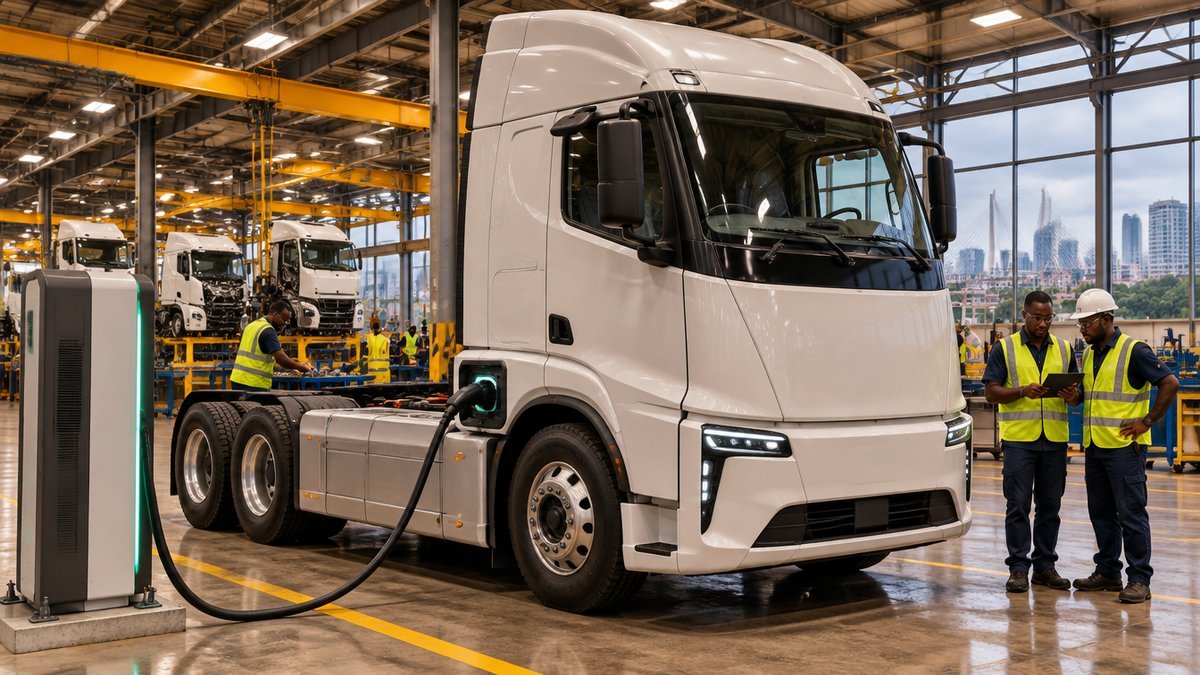
Nigeria has rolled out its first locally assembled heavy-duty electric truck. On Sunday, 15 November 2026, Dangote Sinotruk West Africa Limited unveiled the truck at its assembly plant in Ikeja, Lagos. The company is a joint venture between the Dangote Group and China’s Sinotruk Group. Sinotruk’s president, Liu Wei, called it “the first new-energy truck to be assembled on the African continent.”
For haulage operators, fleet owners, logistics startups and anyone who watches diesel prices, this matters more than another EV car launch. Heavy trucks carry most of Nigeria’s goods, and fuel is one of their biggest costs. This explainer covers what was announced, what has not been disclosed yet, what an electric truck could mean for running costs, and the problems still in the way.
What Dangote Sinotruk Actually Announced
The rollout was announced in a Dangote Group statement and covered by several Nigerian outlets. The confirmed facts are these:
- The vehicle: a heavy-duty electric truck assembled at the joint venture’s facility in Ikeja, Lagos. A photo caption in one report called it the “Dangote Sinotruk Andaz”, but the company has not published a full model or spec sheet.
- The claim: Nigeria’s first locally assembled electric heavy-duty truck. Sinotruk says it is also the first new-energy truck assembled in Africa.
- Who spoke: Devakumar Edwin, Group Vice-President of Dangote Industries Limited; Liu Wei, President of Sinotruk Group; and Olasunkanmi Ojowuro, MD of Lagos Bus Services, who represented the Lagos State Commissioner for Transportation.
- After-sales: Edwin said the company is setting up a team to provide charging infrastructure, technical expertise, spare parts and after-sales support for the electric trucks.
- Skills: Sinotruk will train Nigerian engineers and technicians. Some staff will get practical training at Sinotruk facilities in China.
Edwin said the electric truck’s lower operating costs and reduced tailpipe emissions could benefit operators, but that this depends on electricity costs and charging infrastructure. That condition is the most important part of the announcement, and we return to it below.
What We Don’t Know Yet
Reports of the launch did not include any of the details a truck buyer needs. As of publication, Dangote Sinotruk has not publicly confirmed:
- The price in Naira, or whether the truck will be sold outright, leased or offered on fleet financing
- Battery capacity (kWh) and real-world range with a full load
- Charging time and the type of charger it needs
- Payload and gross vehicle weight rating
- Production volume, meaning how many electric units will be built and when ordinary customers can buy one
- The local content percentage, meaning how much is made in Nigeria and how much is imported as kits
Treat any electric truck price you see on social media or from middlemen as speculation until the company or an authorised dealer gives you a written quote. We will update our coverage when official specifications and pricing are published.
The Plant Behind the Truck: A Quick History
Dangote Sinotruk is an established assembler that has been building trucks in Lagos for close to a decade. The key milestones reported at the launch were:
- 2010 – Dangote and Sinotruk begin their partnership. Edwin said Dangote chose Sinotruk as its technology partner after evaluating several Chinese truck makers.
- 2014 – The joint venture is formally established.
- 2017 – The first heavy truck rolls off the Lagos line. The plant was reported at the time as a $100 million facility designed to assemble up to 10,000 vehicles a year.
- 2024 – A commercial vehicle welding and e-coating paint line, for completely knocked-down (CKD) truck cab assembly, becomes operational.
- 2026 – More than 8,000 vehicles have been assembled locally, according to Liu Wei, and the first electric heavy-duty truck rolls off the line.
The plant’s range already includes heavy-duty trucks, tippers, light trucks, pickups and buses. The Dangote Group also adopted CNG before moving to electric. Dangote’s refinery began delivering fuel to retailers in 2025 using CNG-powered tankers. The group appears to be testing several alternatives to diesel at once, which makes sense for a company that runs one of Nigeria’s largest truck fleets through its cement business.
Why an Electric Truck Matters for Nigerian Haulage
Haulage cost is built into nearly everything Nigerians buy, including cement, food, fuel and building materials. When diesel prices rise, transporters raise their rates and prices go up across the market. Cutting fuel costs in haulage could therefore affect the economy well beyond the transport sector.
The general case for electric trucks in Nigeria rests on four points:
- Energy cost per kilometre: Electric drivetrains are much more efficient than diesel engines. If the electricity is reasonably priced and reliable, the cost of energy per kilometre can be well below diesel.
- Fewer moving parts: An electric truck has no engine oil, fuel injectors or turbocharger to service. Over time this can lower routine maintenance costs, although brakes, tyres and suspension still wear, especially on Nigerian roads.
- Protection from fuel price swings: Diesel prices in Nigeria move with crude oil prices, the exchange rate and refinery supply. A fleet running partly on electricity is less exposed to those shocks.
- Emissions and urban air quality: Lagos, Kano and Port Harcourt all have heavy truck traffic. Electric trucks produce no tailpipe emissions.
These are general advantages of the technology, not tested results for this truck. Real savings will depend on the truck’s efficiency, the route, the load and, above all, where the electricity comes from.
The Big Catch: Power and Charging
Nigeria’s grid problems are the main obstacle for electric trucks. Arise News reported in August 2026 that the national grid generates only about 4,000 MW for a population of more than 200 million. Charging stations, dealerships and battery-swap operators often fall back on diesel or petrol generators when grid power fails.
Public charging is also thin. The same report counted about 48 public charging stations in late 2025, mostly in Lagos and Abuja. A heavy truck needs a lot of energy per charge, and most of those stations were built for cars, not trucks.
Charging a truck from a diesel generator wipes out much of the fuel saving, because the operator is still paying for diesel. For an electric truck to make financial sense in Nigeria, an operator will probably need one or more of these:
- A depot charger on a reliable grid feeder, such as a Band A feeder, or on a captive power arrangement
- Solar plus battery storage at the depot to cover daytime charging
- Short, predictable routes, such as port-to-warehouse shuttles, quarry runs or intra-city distribution, where the truck returns to base every day
- Manufacturer-backed charging support, which Dangote Sinotruk says it is preparing
Long-distance routes such as Lagos–Kano or Port Harcourt–Abuja are a much harder case until high-power charging exists along the major highways.
How It Fits Nigeria’s Wider EV Push
The truck arrives in a year of several EV policy moves:
- Import duty and VAT: EVs were exempted from VAT in 2024. Import duty on EVs was cut from 5% to zero in 2026, and the government also cut duty on mass-transit buses to zero. Our earlier explainer on EV import duty in Nigeria and who gets the waiver covers the details.
- Tax waivers: Authorities approved tax waivers for nearly 4,000 EVs imported in the first half of 2026. This was the first batch processed under a new government programme.
- Fleet charging hubs: In May 2026, Possible Electric Mobility said its Abuja hub, described as Africa’s largest EV charging hub, could charge more than 1,000 EVs a day. The hub is aimed at electric buses and commercial fleets.
- Local assembly: NADDC has said Nigeria has the capacity to produce 500,000 vehicles a year. Local assembly of electric commercial vehicles supports that goal. See our guide to locally assembled cars in Nigeria for the passenger-car side.
Dealers estimate that EVs still make up less than 1% of Nigeria’s vehicle fleet. Commercial fleets with fixed routes and their own depots may adopt EVs faster than private car owners, because they can plan charging around a schedule.
Electric vs Diesel vs CNG Trucks: How They Compare
The list below is a general comparison of the three options available to Nigerian fleet operators. It is not based on test data for the new truck.
- Diesel truck – Proven, with spare parts and mechanics everywhere and long range. However, it is fully exposed to diesel price swings and has the highest fuel cost per kilometre of the three.
- CNG truck – Cheaper fuel than diesel, and the federal government has pushed CNG adoption. However, filling stations are still limited outside major corridors. Our CNG conversion cost guide covers the trade-offs.
- Electric truck – Potentially the lowest energy and maintenance cost if charged from grid or solar power, with no tailpipe emissions. However, the upfront price is likely to be higher, range and charging are limited, it depends heavily on power supply, and few mechanics have experience with it yet.
Who Should Pay Attention
- Logistics and distribution companies running fixed urban routes in Lagos, Abuja or Port Harcourt
- Port and terminal haulage operators with short, repeated trips
- Manufacturers and FMCG firms that already have solar or captive power at their plants
- State governments and transport agencies planning low-emission fleets
- Investors and fleet financiers looking at clean-transport assets
If you run one or two trucks on long interstate routes, wait and see. Let the first fleet operators show how the trucks perform on Nigerian roads, in Nigerian heat and on Nigerian power before you commit.
Honest Drawbacks to Weigh
- No published specs or price yet. You cannot work out a business case without them.
- Charging infrastructure is not ready for heavy trucks in most of the country.
- Mechanics with EV skills are scarce. Dangote Sinotruk’s training plans may help, but it will take time for skills to reach the repair workshops truckers use. Nigerian mechanics already struggle with newer vehicle technologies, as BusinessDay reported this week on after-sales pressure facing carmakers.
- Battery replacement cost and warranty terms have not been disclosed. For an electric truck, these matter as much as the purchase price.
- Resale value is untested, because no used electric trucks have been sold in Nigeria yet.
FAQ: Dangote Sinotruk Electric Truck
Is this the first electric truck in Nigeria?
It is described as the first locally assembled heavy-duty electric truck in Nigeria. Sinotruk also says it is the first new-energy truck assembled in Africa.
What is the price of the Dangote electric truck in Nigeria?
The price has not been announced. Ask Dangote Sinotruk or an authorised dealer for an official quote. Do not rely on unofficial figures online.
Where is it assembled?
At Dangote Sinotruk West Africa’s assembly plant in Ikeja, Lagos.
Can I charge it from a generator?
Technically yes, but if you charge with diesel, most of the fuel saving disappears. Grid power on a reliable feeder, or solar, is what makes the running costs work.
Do EVs pay import duty in Nigeria?
Import duty on EVs was cut to zero in 2026, and EVs have been exempt from VAT since 2024. Confirm the current status with the Nigeria Customs Service before importing.
Key takeaway: The launch is a real milestone for local assembly and for cleaner haulage in Nigeria. Until Dangote Sinotruk publishes the price, range, charging specifications and warranty terms, it is a development to watch rather than a truck to order. If you run fixed-route fleets in Lagos or Abuja, now is a good time to start talking to the company about depot charging and pilot units.
Vehicle prices, import duties and specs change frequently in Nigeria. Always confirm current figures with the dealer or official source before buying.
Information in this article is based on statements from the Dangote Group and Sinotruk reported on 15–16 November 2026, and on earlier reporting by Arise News, The Business Times and BusinessDay.