For years the argument against buying an electric car in Nigeria ended the same way: where exactly will you charge it? That question just got a more interesting answer. In September 2026, NNPC Ltd announced that it will deploy between 50 and 70 “smart” self-service energy stations across the country within six months — sites that dispense petrol and diesel but also offer electric vehicle charging, LPG, CNG, vehicle maintenance and automated car wash under one roof.
This is not a concept drawing. The first of these stations is already open, a 24-hour facility along Bill Clinton Drive on Airport Road, Abuja. If the rollout lands anywhere near the stated target, it would be the single biggest expansion of EV charging access Nigeria has seen — and it would come from the national oil company, not an EV startup.
What NNPC actually announced
NNPC Retail described the plan as turning conventional filling stations into “energy hubs” rather than fuel-only forecourts. The stated numbers, per the company’s September 2026 statements, are 50 to 70 stations inside a six-month window.
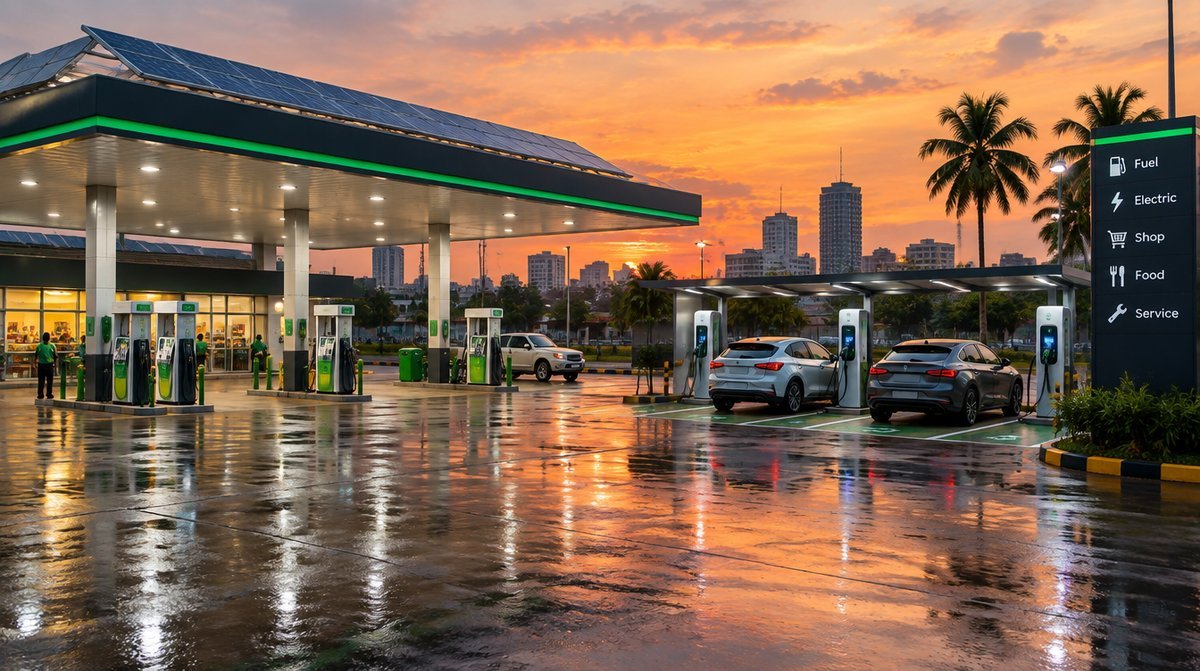
The Abuja flagship gives a sense of what a finished site looks like:
- Fuel: 16 petrol pumps and two diesel dispensing pumps
- Storage: 180,000 litres of PMS (petrol) and 45,000 litres of AGO (diesel)
- EV charging: fast chargers rated to deliver a useful charge in roughly 30–40 minutes, depending on the vehicle and how empty the battery is
- Power: a 200kWh solar system supporting the site
- Gas: LPG and CNG services, with some stations also hosting CNG conversion workshops
- Extras: self-service payment, vehicle maintenance, automated car wash, food
The solar detail matters more than it looks. A charger that depends purely on grid supply is a charger that goes dark when the feeder does. Pairing charging bays with on-site solar is the difference between a station that works and a station that works sometimes.
Why this matters for EV charging in Nigeria
Public charging in Nigeria today is thin and heavily concentrated. Lagos has roughly 22 confirmed public charging locations as of 2026, with MAX running the largest network — about 16 sites spread across Lekki, Ajah, Ikoyi, Ikeja, Yaba, Surulere, Egbeda and Alapere. Qoray Mobility operates a handful more, including 60kW DC fast chargers at hotel locations in Ikeja. Abuja has a smaller cluster around the airport corridor and the central business district. Outside those two cities, an EV owner is essentially charging at home or not driving far.
That is the constraint a fuel retailer is uniquely positioned to break. NNPC does not have to acquire land, secure it, or build a forecourt — it already owns hundreds of them on the exact roads people drive. Adding charging bays to existing sites is a far cheaper path to national coverage than building EV-only stations from scratch.
The market forecasts have noticed. Nigeria’s EV charging station market has been projected to grow at about 27.4% compound annual growth through 2035, reaching a projected value of roughly $13.97 billion. Forecasts are forecasts — but the direction of travel is not in dispute.
The honest caveats
A few things worth keeping in perspective:
- 50–70 stations is a target, not a delivery. Nigerian infrastructure announcements have a long history of slipping. Judge it in six months.
- “Smart station” does not automatically mean “many chargers.” A site with two charging bays serves very few cars per day compared with 16 petrol pumps.
- Nothing has been said publicly about charging tariffs at these stations. Until a per-kWh price is published, cost-of-ownership maths stays theoretical.
- Coverage will almost certainly start in Abuja and Lagos. Port Harcourt, Kano, Ibadan and Enugu drivers should wait for confirmed site lists before making purchase decisions.
What it costs to charge an electric car in Nigeria right now
Until NNPC pricing lands, here is the current landscape, based on published 2026 rates. Treat every figure as an estimate that moves with tariffs and FX.
- Home charging (grid): under NERC’s September 2026 tariff order, Eko Disco Band A customers pay about ₦209.50 per kWh. Lower bands pay considerably less, and typical published ranges across bands fall somewhere around ₦150–₦230 per kWh.
- Public AC charging: roughly ₦300 per kWh at some Qoray Mobility sites.
- Public DC fast charging: around ₦430 per kWh advertised by CAAS Charging in Lagos and Abuja; about ₦500 per kWh for DC at some Qoray locations.
Run that against a typical compact EV consuming roughly 15–18 kWh per 100km:
- Charging at home on Band A: roughly ₦3,100–₦3,800 per 100km
- Charging on a public DC fast charger: roughly ₦6,500–₦7,700 per 100km
- A petrol car doing 10 litres per 100km at recent pump prices near ₦1,350 per litre: roughly ₦13,500 per 100km
The pattern is consistent: even the expensive way of charging an EV in Nigeria currently undercuts petrol on a per-kilometre basis, and home charging undercuts it dramatically. What EVs do not undercut is the upfront price — and that remains the real barrier for most buyers.
The CNG angle may be the bigger story
Buried in the announcement is a detail that will affect far more Nigerian drivers than EV charging will this year: some smart stations will host CNG conversion facilities on site, so a motorist can have a vehicle converted while using other services.
CNG is the pragmatic middle path. You keep the car you already own, you keep the ability to run on petrol, and you cut your fuel bill substantially. Published 2026 conversion costs for private vehicles sit broadly in these ranges:
- Sedans and small cars (Corolla, Camry class): about ₦350,000–₦600,000
- SUVs and mini-buses: about ₦500,000–₦900,000
- Heavy commercial buses and trucks: about ₦1 million–₦1.7 million
CNG itself has been selling in the region of ₦200–₦250 per standard cubic metre in some states, which is why the payback arithmetic works for high-mileage drivers even at those conversion prices. A private car doing 40km a day will take a long time to recover ₦500,000. A commercial bus doing 200km a day is a different calculation entirely.
There is also a subsidised route. Under the Presidential CNG Initiative, a programme of free conversion kits for commercial vehicles has been rolled out through transport unions, with approved free-conversion centres in Lagos and other states. Eligibility is generally tied to registration with bodies such as NURTW or RTEAN, or to state-owned taxi fleets. Private owners largely pay full price.
Should this change your next vehicle decision?
A measured read, depending on who you are:
- If you were already EV-curious and live in Lagos or Abuja: the charging picture is improving faster than it was two years ago. It is still not a solved problem, and you should plan on home charging being your primary method, with public charging as backup rather than the reverse.
- If you live outside the two main cities: hold. Buying an EV before confirmed charging exists on your route is buying a problem.
- If you drive high mileage on petrol: CNG conversion is probably the better financial move today, and it gets easier if conversion workshops genuinely appear at fuel stations.
- If you run a commercial vehicle: check whether you qualify for a free conversion under the Presidential CNG Initiative before paying anyone a naira.
- If you are buying tokunbo: nothing here changes your calculation. Clearing costs and FX still dominate.
Key takeaways
- NNPC Ltd says it will deploy 50–70 smart energy stations nationwide within six months, combining petrol, EV charging, LPG, CNG and maintenance services.
- The first station is open in Abuja on Bill Clinton Drive, Airport Road, with 16 petrol pumps, fast EV chargers rated at roughly 30–40 minutes, and a 200kWh solar system.
- Public EV charging in Nigeria currently runs about ₦300–₦500 per kWh; home charging on the grid is far cheaper at roughly ₦150–₦230 per kWh depending on band.
- Even expensive public charging still beats petrol per kilometre at current pump prices — the EV problem in Nigeria is purchase price and charger availability, not running cost.
- CNG conversion remains the cheaper, more practical switch for most drivers, at roughly ₦350,000–₦900,000 for private vehicles, with free conversions available to qualifying commercial operators.
- Wait for confirmed site lists and published charging tariffs before treating this as a reason to buy an EV.
Frequently asked questions
Will NNPC smart stations charge any electric car?
The Abuja station uses fast chargers, and most modern EVs sold into the Nigerian market support DC fast charging through common connector standards. No connector specification has been published per site, so confirm compatibility with your specific vehicle before relying on a station.
How long does charging take at these stations?
NNPC has indicated roughly 30 to 40 minutes at the Abuja facility, depending on the vehicle and how depleted the battery is. Charging speed slows significantly above about 80% on most EVs, so real-world stops are usually shorter than a full charge.
Is it cheaper to run an EV or convert to CNG in Nigeria?
Per kilometre, a home-charged EV is typically the cheapest to run. But CNG conversion costs a fraction of buying an EV, works with the car you already own, and does not depend on charger availability. For most Nigerian drivers today, CNG is the more accessible saving.
Where can I charge an electric car in Nigeria today?
Mostly Lagos and Abuja. Lagos has around 22 confirmed public charging locations, the majority operated by MAX, with additional sites from Qoray Mobility. Abuja’s cluster is smaller and concentrated around the airport corridor and central district.
The bottom line
Nigeria’s EV problem was never really about the cars. It was about the sockets. An oil company deciding to put chargers on forecourts it already owns is a more serious answer to that problem than any number of import-duty waivers, because it attacks the part of the equation that money alone cannot fix quickly: physical coverage on real roads.
Whether 50 to 70 stations actually materialise in six months is the open question. But the first one exists, it is running, and it has chargers. That is further than this conversation has ever got before.
Vehicle prices, import duties, fuel and electricity tariffs, and specifications change frequently in Nigeria. Always confirm current figures with the dealer, the station operator, or the relevant official source before buying or converting.
Reporting in this article draws on September 2026 statements from NNPC Ltd and NNPC Retail, NERC’s September 2026 tariff order, and published 2026 rates from Nigerian charging operators and CNG conversion centres.