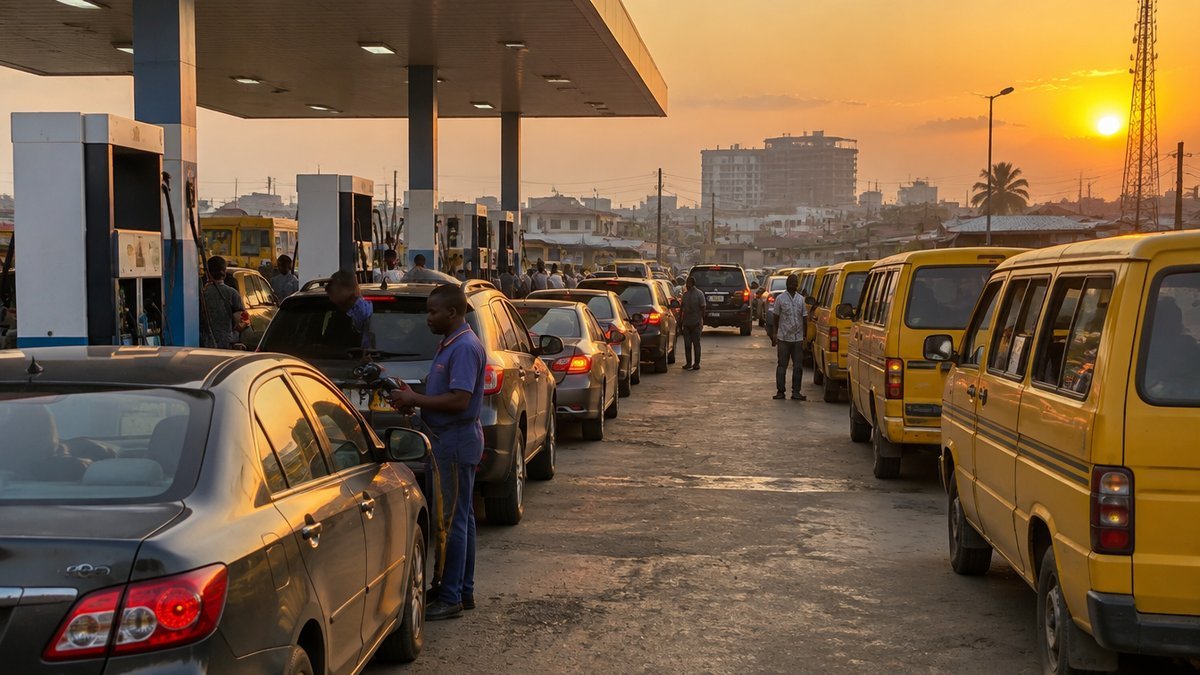
If your fuel budget felt broken this week, you were not imagining it. The Dangote Petroleum Refinery raised its petrol gantry price by 6.7 per cent to ₦1,350 per litre, up from ₦1,265, with effect from 12 September 2026. That is the fourth upward review in just over three weeks, and it lands directly on every Nigerian who drives, rides or pays for transport.
This post is not another headline. It is a working calculation: what the new petrol price in Nigeria actually costs you per kilometre, what your realistic monthly fuel bill now looks like by vehicle type, how okada and delivery riders are affected, and whether CNG or an electric car genuinely saves money at these numbers.
What just changed: three weeks, ₦185 a litre
The gantry price is the wholesale, ex-depot price at which marketers load petrol from the refinery. It is not what you pay at the pump, but it sets the floor for it. Here is how that floor has moved since late August, per the refinery’s own published adjustments:
- 21 August 2026 — ₦1,165 to ₦1,185 per litre
- 26 August 2026 — ₦1,200 per litre
- 29 August 2026 — ₦1,265 per litre
- 12 September 2026 — ₦1,350 per litre
That is roughly ₦185 added to the wholesale cost of a litre in under a month, an increase of about 16 per cent. The stated driver is renewed volatility in the international crude market, with Brent crude recently trading above $100 per barrel. Because Nigerian refining still buys crude at international prices, a global oil spike reaches Lagos pumps whether or not the fuel was refined locally.
What you will actually pay at the pump
Pump prices sit above the gantry price because of haulage, depot margins, station overheads and retailer profit. Through early September, petrol was selling roughly between ₦1,300 and ₦1,400 per litre at retail outlets nationwide, with some Lagos stations reported around ₦1,310 and others already above ₦1,400. Depot prices in Lagos on 8 September were reported in the ₦1,266 to ₦1,280 range.
There is an important wrinkle here. Marketers, including the Independent Petroleum Marketers Association of Nigeria, had been signalling that pump prices would come down as depot rates eased. Instead, many stations held their prices up while wholesale rates fell, which is exactly why the complaint about the gap between loading cost and retail price keeps resurfacing. Now that the gantry price has jumped again, expect stations that never cut to be the first to raise.
Practical implication: the price on the board varies more by station and by state than most drivers assume. In the North East and parts of the South South, where haulage distances are longest, the pump price is routinely the highest in the country. Checking two or three stations before filling is no longer penny-pinching, it is worth real money.
The real cost per kilometre at ₦1,350 a litre
Pump price alone tells you nothing useful. What matters is how much fuel your specific car burns. The figures below are our own calculations using ₦1,350 per litre and typical real-world Nigerian consumption, which is worse than manufacturer claims because of traffic, air conditioning and road surface.
- Small hatchback (about 6 litres per 100 km) — roughly ₦81 per km, ₦8,100 per 100 km
- Mid-size saloon, well maintained (about 8 litres per 100 km) — roughly ₦108 per km, ₦10,800 per 100 km
- Older saloon or small crossover (about 10 litres per 100 km) — roughly ₦135 per km, ₦13,500 per 100 km
- Mid-size SUV in Lagos traffic (about 12 litres per 100 km) — roughly ₦162 per km, ₦16,200 per 100 km
- Large V6 SUV (about 14 litres per 100 km) — roughly ₦189 per km, ₦18,900 per 100 km
Your monthly fuel budget
Take a fairly ordinary commuter doing 1,500 km a month, which is about 50 km a day of combined commuting and errands. At ₦1,350 per litre:
- Efficient saloon at 8 L/100 km burns 120 litres — about ₦162,000 a month
- Average car at 10 L/100 km burns 150 litres — about ₦202,500 a month
- Thirsty SUV at 14 L/100 km burns 210 litres — about ₦283,500 a month
For that average driver burning 150 litres a month, the ₦185 wholesale increase since 20 August translates into roughly ₦27,750 extra per month if it passes through fully to the pump. That is a meaningful hit to a household budget, and it arrives on top of insurance, servicing and registration costs that have all climbed this year.
This is also the arithmetic that makes fuel-efficient cars in Nigeria worth paying a premium for. The gap between an 8 L/100 km saloon and a 14 L/100 km SUV is about ₦121,500 a month at this price, or nearly ₦1.46 million a year. That difference alone can outweigh the purchase price gap between the two vehicles within a few years.
What this does to okada and delivery riders
Commercial riders feel fuel price moves faster than anyone, because fuel is a direct input to a thin daily margin rather than a monthly household line item.
A typical 125cc to 150cc commercial motorcycle returns somewhere around 35 to 45 km per litre in mixed use. Take 40 km per litre and a rider covering 100 km a day: that is 2.5 litres, or about ₦3,375 a day in fuel at the new price. Over 26 working days, roughly ₦87,750 a month. The three-week increase adds about ₦12,000 a month to that rider’s costs.
Riders on delivery platforms generally cannot raise their own rates, so the squeeze shows up as longer hours rather than higher earnings. Two responses are worth considering: negotiating fuel-adjusted rates where the platform allows it, and looking seriously at electric two-wheelers, where the per-kilometre energy cost is a fraction of petrol and the maintenance burden is lower. Riders in states with okada restrictions should also confirm the rules for their route before investing in any new machine.
Is CNG actually cheaper? The honest numbers
Compressed natural gas is the alternative the federal government has pushed hardest, and at current prices the running-cost case is strong. CNG has been reported at around ₦380 per standard cubic metre (SCM) for cars and passenger buses, and about ₦450 per SCM for heavy-duty vehicles. Prices vary sharply by location, reported anywhere from roughly ₦230 to over ₦500 per SCM depending on distance from pipeline infrastructure, with some Enugu stations quoted around ₦200 to ₦250.
One SCM of CNG delivers roughly the energy of one litre of petrol. That is an approximation, not a precise conversion, and real-world results depend on your engine and the quality of the conversion. But even treating it loosely, a driver who would burn 150 litres of petrol a month at ₦202,500 might spend in the region of ₦57,000 on CNG at ₦380 per SCM. That is a saving of well over ₦140,000 a month for a high-mileage driver.
The catches are real, though:
- Upfront conversion cost — a genuine cash outlay that only pays back if you drive a lot. Our CNG conversion cost guide covers current pricing and the safety questions in detail.
- Station availability — refuelling is straightforward in parts of Lagos, Abuja and the gas-producing states, and difficult almost everywhere else. Queues at the cheaper stations can be long.
- Installation quality — a badly done conversion is a safety problem, not just a performance one. Use a certified workshop, never a roadside fitter.
- Boot space and resale — the cylinder takes space, and some buyers discount converted vehicles.
And electric cars?
On pure energy cost, an EV beats both petrol and CNG in Nigeria, especially if you charge from solar. Policy is moving too: the government approved tax waivers for nearly 4,000 electric vehicles in the first half of 2026 under a programme aimed at speeding up adoption and local assembly.
The obstacle is not the car, it is the plug. Public charging remains thin, with only around a dozen public charging stations nationwide as of late 2025, and the grid is unreliable enough that most realistic EV owners are also buying solar and battery storage. That pushes the true entry cost well above the sticker price. If you are weighing it up, our guide to EV charging in Nigeria sets out where you can actually charge and what it costs.
Seven ways to cut your fuel bill this month
- Fix your tyre pressure. Under-inflated tyres are the single most common avoidable fuel waster on Nigerian roads. Check monthly, cold.
- Service the basics. A clogged air filter, tired spark plugs or a failing oxygen sensor can cost you double-digit percentages in consumption.
- Stop idling in traffic. If you will be stationary more than a minute or two and the car restarts reliably, switch off.
- Drop the dead weight. Roof racks, spare loads and boot clutter all cost fuel, especially at highway speed.
- Drive the gap, not the brake. Smooth acceleration and early lifting off the throttle beat hard acceleration followed by braking, every time.
- Compare stations deliberately. With retail prices spread across a ₦100-plus range, a 150-litre month can swing by ₦15,000 on station choice alone.
- Combine trips. A cold engine is at its least efficient for the first few kilometres, so three short separate trips cost far more than one longer combined one.
Key takeaways
- The wholesale petrol price is now ₦1,350 per litre, a 6.7 per cent rise effective 12 September 2026 and the fourth increase since 21 August.
- Pump prices have been running roughly ₦1,300 to ₦1,400, and stations that did not cut when depot rates fell are likely to raise quickly now.
- At ₦1,350 a litre, an average car costs about ₦135 per kilometre to fuel, or around ₦202,500 a month for a 1,500 km commuter.
- Fuel efficiency is now worth more than ever — the gap between an efficient saloon and a large SUV is over ₦1.4 million a year.
- CNG offers the largest running-cost saving available today, but only if you have reliable station access and enough mileage to recover the conversion cost.
- EVs win on energy cost but lose on infrastructure, so budget for solar and storage rather than assuming you can rely on public chargers.
Frequently asked questions
Will pump prices definitely rise to match the new gantry price?
Not uniformly. Stations holding older, cheaper stock may delay, and competition in dense urban areas can slow the pass-through. But historically the increase arrives within days rather than weeks, and rural and long-haul locations tend to see the largest jumps.
Is it worth buying a smaller car right now?
If you cover high mileage, the fuel saving is substantial and compounds monthly. If you drive under about 800 km a month, the saving is smaller than the transaction costs of switching cars, so improving the efficiency of the car you own is usually the better move.
Does CNG damage a petrol engine?
A properly engineered conversion on a suitable engine, installed by a certified workshop with quality components, is widely used worldwide. Poor installations, cheap kits and unsuitable engines are where the problems come from. Certification is not optional.
Why does petrol cost more in Nigeria when we produce crude?
Crude is traded at international prices, so refineries buy it at global market rates regardless of where it is pumped. When Brent rises above $100 per barrel, the input cost for domestic refining rises with it, and that flows through to the pump.
Vehicle prices, fuel prices, import duties and specifications change frequently in Nigeria. Always confirm current figures with the dealer, the filling station or the relevant official source before making a purchase or budgeting decision.
Price and policy figures in this article reflect reporting current as at 12 September 2026, including published Dangote Petroleum Refinery gantry price adjustments and market reports on retail and depot pricing. Cost-per-kilometre and monthly budget figures are our own calculations based on the stated assumptions.