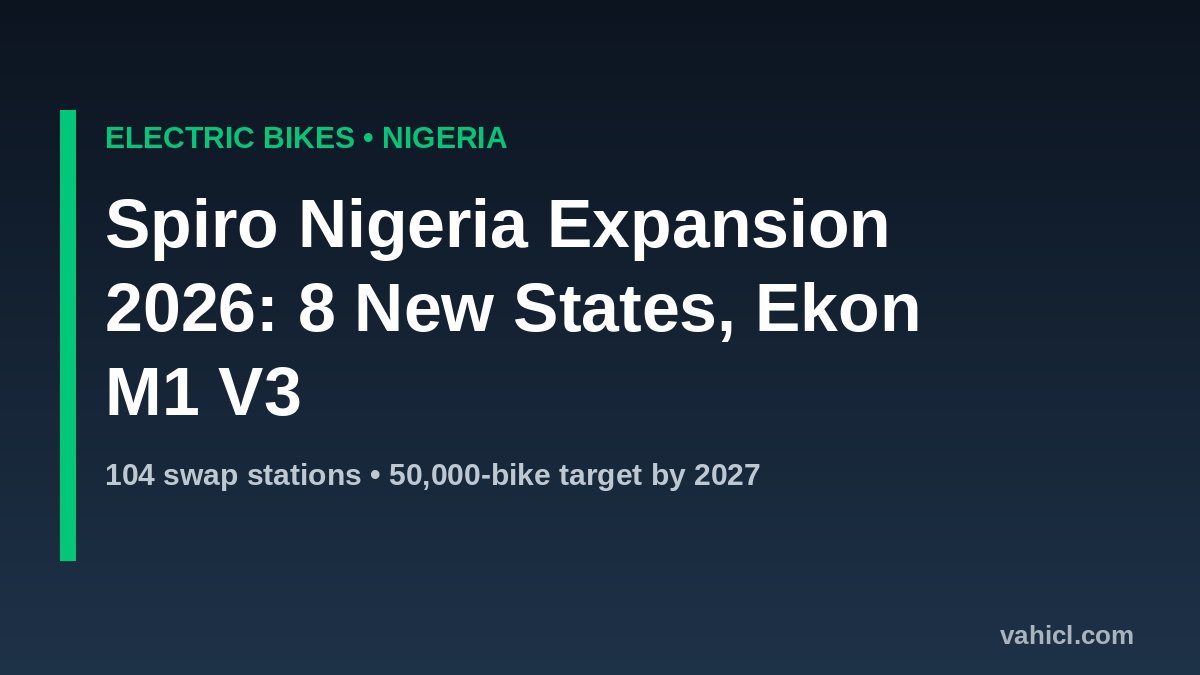
Spiro, the battery-swap electric motorcycle company that has become the most visible name in Nigeria’s e-okada market, has laid out its biggest local plan yet. At its second Media Connect event in Lagos, reported by Techeconomy on 18 November 2026, the company named Prasad Sane as country head and managing director, unveiled the Ekon M1 Version 3, and said it wants about 50,000 bikes sold in Nigeria by 2027, with eight more states added over the next two years.
For okada riders, dispatch riders and anyone weighing an electric bike against a petrol Bajaj or TVS, this matters more than a typical product launch. A battery-swap bike is only as useful as the swap network around it, and right now that network only covers three states. Here is what was announced, what it changes, and what you should check before you commit money.
What Spiro Announced in Lagos
According to the Techeconomy report on the event, these are the headline figures Spiro shared for Nigeria:
- Current footprint: Lagos, Ogun and Oyo states.
- Swap stations: 104 battery-swapping stations in Nigeria today, with a goal of roughly 200 by 2028.
- Service centres: 11 service stations, a mix of company-owned and franchised sites.
- Sales target: about 50,000 bikes by 2027, and 100,000 on Nigerian roads within two to three years.
- Expansion: four new states in 2027 and four more in 2028. The specific states were not named in the report.
- New model: the Ekon M1 Version 3 was unveiled and demonstrated. No Naira price, range, battery capacity or top speed was published for it.
- Dealers: a planned “3S” dealer format covering sales, service and spares.
Across Africa, Sane said Spiro has deployed 160,000 electric motorcycles, completed 60 million battery swaps and covered about three billion kilometres. The company started in Togo and Benin before moving into Kenya, Uganda and Rwanda, and says it aims to be in 11 African countries by December 2026.
Why the Swap Network Is the Real Story
With a petrol okada, fuel is everywhere. Any filling station or roadside seller can top you up. With a battery-swap bike, you ride on a battery the company owns and exchange it for a charged one at a Spiro station. That swap typically takes a couple of minutes, which is faster than charging a battery at home. But it ties you to where those stations are.
That is why the station count matters more than the bike itself. 104 stations spread across Lagos, Ogun and Oyo is a workable network for a rider who works inside Lagos metropolis or the Ibadan axis. Outside those corridors, today, a swap bike is a hard sell. Doubling to about 200 stations by 2028, while also adding up to eight states, means the network will be thin in each new state at first. Early adopters in a newly launched state should expect fewer stations and longer detours than Lagos riders get.
What to ask before you buy in a new state
- How many swap stations are within your daily working radius, not just in the state capital?
- What are the station opening hours? A station that closes at 8pm is a problem for night dispatch work.
- Where is the nearest of the service centres, and how long does a typical repair take?
- What happens to your bike payments if a station near you closes or runs out of charged batteries?
How Payments and Remote Control Work
Two details from the Lagos event deserve attention from anyone planning to ride for a living.
Prepaid wallet swaps. Swaps are paid through OPay, Moniepoint or Spiro’s own app, and Sane was clear that you need money in your digital wallet before you can swap. In plain terms, no balance means no fresh battery. Riders who are used to buying ₦2,000 of fuel from cash in their pocket will need to keep their wallet topped up, especially at the end of a long day.
Remote lock and shutdown. Spiro bikes come with remote locking, speed limiting, real-time tracking and remote shutdown. Sane told the event that the company can shut down any bike on the road with its remote control. This is good news for theft, which is a serious problem with okadas in Nigeria, and it is a big part of why lenders and fleet owners are willing to finance these bikes. But it also means that if you fall behind on a hire-purchase or lease plan, the bike can be stopped. Read your agreement carefully and understand exactly when the company can lock your bike.
Electric Bike Price in Nigeria: What We Actually Know
Spiro did not publish a Naira price for the Ekon M1 Version 3 in the coverage of the event. Do not trust any social media post claiming a “new price” until it comes from Spiro or an authorised dealer.
For a general sense of the market, Al Jazeera reported in August 2026 that electric motorcycles in Nigeria typically cost about ₦1 million. That is a broad market figure, not a Spiro quote, and actual prices vary by brand, battery arrangement and whether the battery is included or leased. Because swap bikes usually separate the bike price from the battery and energy cost, compare total weekly cost, not just the sticker price.
We have broken down running costs in more detail in our guide to the real cost of an electric okada versus a petrol bike, and current pump prices are covered in our November 2026 petrol price update.
Electric vs Petrol Okada: Quick Comparison
- Refuelling: petrol bikes refuel anywhere; swap bikes need a Spiro station, which today means Lagos, Ogun or Oyo.
- Upfront price: petrol bikes have a well-established tokunbo and new market; e-bikes are typically around ₦1 million according to Al Jazeera’s August reporting, with financing plans common.
- Daily running cost: fuel prices remain high after the 2023 subsidy removal, and riders interviewed by Al Jazeera reported meaningful weekly savings and no engine oil spending on electric bikes.
- Maintenance: electric motors have far fewer moving parts, but battery and electronics repairs depend on the brand’s service network.
- Spare parts: petrol bike parts are sold in every market; e-bike parts mostly come through the brand’s own service centres for now.
- Security: GPS tracking and remote shutdown make e-bikes harder to steal and resell.
Who Should Consider a Spiro Bike Now
If you ride commercially in Lagos, Ogun or Oyo and most of your trips stay within reach of the existing swap stations, the economics of an electric okada have become hard to ignore. Delivery riders working fixed zones, such as food or parcel dispatch, are the best fit because their routes are predictable.
If you live in a state Spiro has not yet entered, wait. The company has said where it is going in broad terms, but not which states or when exactly. Buying a swap bike before stations open in your area means relying on home charging, which brings its own problem: Nigeria’s unreliable grid. Al Jazeera’s reporting from Gombe described a rider whose charger burned out because he did not use a stabiliser. Clean-energy entrepreneur Muhammad Abubakar, CEO of Sustenaa, told the outlet that charging from generators simply moves the emissions elsewhere and argued for solar-powered swap stations instead.
Also check your local rules. Several states restrict commercial motorcycles in parts of their cities, and an electric motor does not exempt you. See our state-by-state okada ban guide before you invest.
Honest Drawbacks
- The network is limited to three states today, and expansion dates for specific states are not yet public.
- Prepaid wallet swaps leave no room for a rider who runs out of balance late in the day.
- Remote shutdown protects the owner and lender more than the rider if a payment is missed.
- No published specs or Naira price yet for the Ekon M1 Version 3, so comparisons with earlier models are guesswork for now.
- Resale value for swap-network e-bikes in Nigeria is still unproven.
Key Takeaways
Spiro says it has 104 swap stations and 11 service centres in Nigeria, aims for about 200 stations by 2028, wants 50,000 bikes sold by 2027, and plans to enter four new states in 2027 and four more in 2028. The new Ekon M1 Version 3 has been shown, but no price or specs have been published.
FAQ
Which states does Spiro operate in?
As of the November 2026 event, Lagos, Ogun and Oyo. Eight more states are planned for 2027 and 2028, but they have not been named publicly.
How much is the Spiro Ekon M1 Version 3 in Nigeria?
No official Naira price was published at launch. Ask an authorised Spiro outlet for the current price and the separate battery or swap plan.
Can I swap a battery without money in my wallet?
No. According to Spiro’s Nigeria MD, you need funds in your OPay, Moniepoint or Spiro app wallet before a swap.
Can Spiro switch off my bike?
Yes. The company says its bikes can be remotely locked, speed-limited and shut down. Check your financing agreement to see when this can happen.
Figures in this article are based on Spiro’s statements at its Lagos Media Connect event as reported by Techeconomy (18 November 2026), and on Al Jazeera reporting from August 2026.
Vehicle prices, import duties and specs change frequently in Nigeria. Always confirm current figures with the dealer or official source before buying.