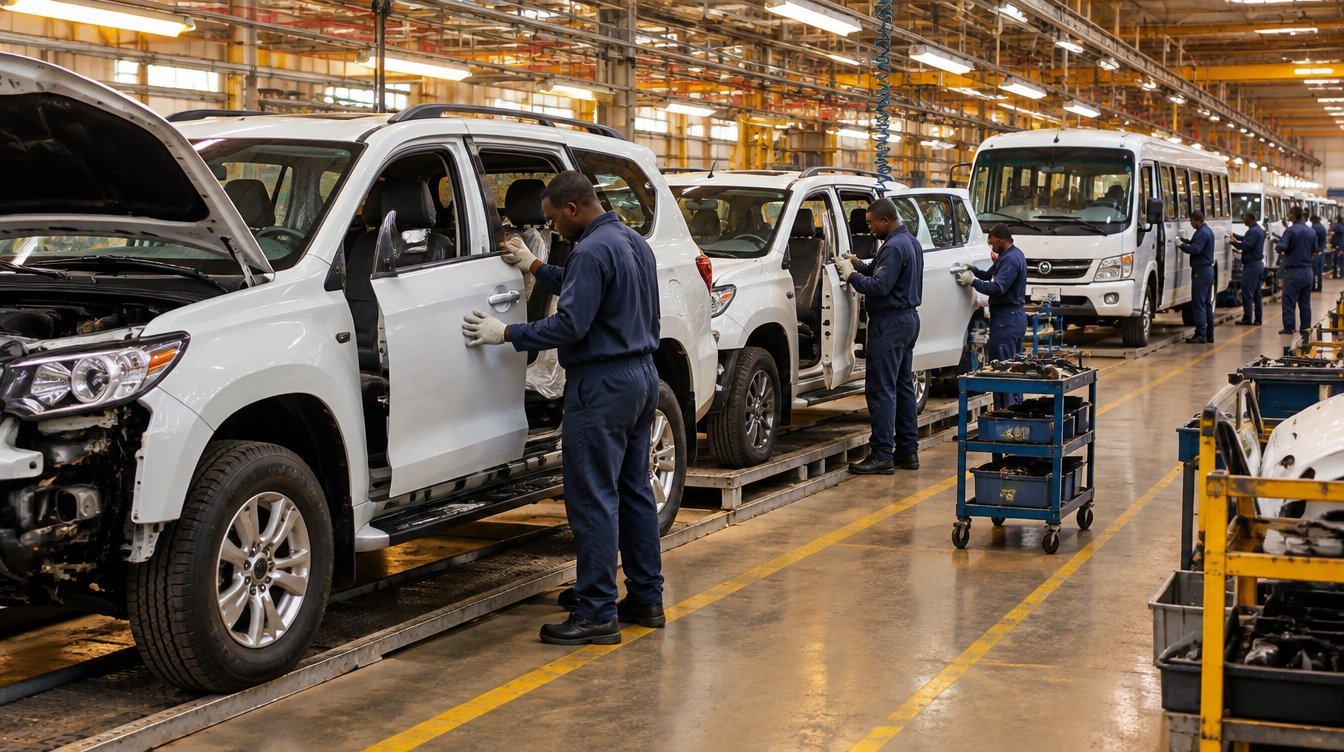
Two announcements in September 2026 have put made-in-Nigeria cars back in the spotlight. On September 11, the Bureau of Public Procurement (BPP) said the Federal Government had approved full implementation of the Nigeria First Policy for vehicle procurement. Federal ministries, departments and agencies (MDAs) now have to buy locally assembled or manufactured vehicles. Then on September 19, the National Automotive Design and Development Council (NADDC) called for a tax waiver on raw materials imported by local vehicle manufacturers, so that Nigerian-built cars can compete on price with imports.
If you are a private buyer, a fleet owner or a small business deciding between a locally assembled car, a brand-new import and a tokunbo, here is what the policy says, what it does not say, and how it could affect the car you buy next.
What the Nigeria First Policy Now Requires
According to the BPP statement released through the Federal Ministry of Information on September 11, 2026, the directive takes effect immediately. It builds on a Secretary to the Government of the Federation (SGF) circular dated May 20, 2026, and on an older SGF circular from April 2011 that already asked MDAs to prefer locally assembled vehicles. The difference this time is enforcement. The key points:
- Local first, by default: all federal MDAs and procuring entities must prioritise and buy domestically assembled or manufactured vehicles, machinery and automotive spare parts.
- Foreign purchases are prohibited unless the designated authority grants an official waiver, which is only possible when local capacity or availability is completely absent.
- Payment needs clearance: payments must be backed by a “No Objection” letter or certificate from the BPP.
- Fleet audit back to 2020: MDAs must submit details of every vehicle in their pool bought from 2020 to date, including purchase date, price, brand, model, VIN, proof of payment and service status.
- Quarterly reporting: every quarterly procurement report must list automotive purchases item by item and show local-content compliance.
- Sanctions: procurement requests that do not comply will be rejected, and the Accounting Officers responsible face sanctions.
One thing to be clear about: this directive covers government procurement, not private buyers. Nobody is stopping you from buying a Toyota Corolla tokunbo or a brand-new Chinese SUV. But government is one of the largest vehicle buyers in the country, so moving its money to local plants can change what gets built, how much it costs and what is available on the market.
Why NADDC Wants a Tax Waiver for Local Manufacturers
The tax waiver call came during an oversight visit by NADDC Director-General Otunba Joseph Oluwemimo Osanipin and board chairman Chief Emma Eneukwu to Innoson Vehicle Manufacturing (IVM) in Nnewi and Kojo Motors in Umunya, both in Anambra State, according to a ThisDay report. The council praised the work both firms are doing on electric (EV) and CNG vehicles. It also acknowledged a long-running complaint from local makers.
That complaint is simple. Local manufacturers pay import duty on inputs like steel and components, and those costs end up in the final price of the vehicle. Meanwhile, some fully built vehicles come in on concessionary or zero-duty terms, so the locally made vehicle can end up costing more than the import. The NADDC DG said the council would take the complaint “to the right quarters” and push for zero duty on raw materials. The board chairman went further and called for full tax on imported vehicles.
Nothing has changed yet. This is advocacy, not an approved policy. No new tariff rate has been announced. If it does go through, it would work in two ways:
- Lower input costs for local plants, which could make made-in-Nigeria vehicles cheaper or at least more stable in price.
- Higher costs for fully built imports, if government adopts the chairman’s call for heavier duties on imported vehicles.
The Bigger Picture: Auto Bill, End-of-Life Rules and Used-Car Checks
The Nigeria First directive is part of a wider push. Three other developments are worth knowing about:
- National Automotive Industry Bill 2026: NADDC has been reviewing the draft with manufacturers, assemblers and component suppliers. Per a Daily Trust report, the DG expects a clean draft by the middle or end of November 2026, ahead of the National Assembly. The aim is to write incentives, local content and standards into law so they do not depend on each new administration’s circulars.
- End-of-Life Vehicle (ELV) policy: Leadership reported that Nigeria plans full implementation in 2026. This covers vehicle recycling and certification of imported used cars before shipment.
- Tighter rules on used imports: NADDC has repeatedly said it wants to curb importation of old used vehicles. We covered the latest import numbers in our breakdown of the ₦633bn car import surge.
What Made-in-Nigeria Cars Cost in 2026
This is where buyers need to be careful. Locally assembled vehicles are not automatically cheap. Many are assembled from semi-knocked-down (SKD) or completely-knocked-down (CKD) kits paid for in dollars, so their Naira prices still move with the exchange rate.
For Innoson, price-list sites currently quote roughly ₦6 million for older models up to ₦40 million or more for SUVs and EVs. At least one Nigerian auto blog lists Innoson’s newer IVM electric range (Link, EX01, EX02) from about ₦38.4 million. These are third-party figures, not official price lists. Treat them as rough estimates and get a written quote from an authorised dealer before you budget.
Rough comparison for a private buyer
- Locally assembled new vehicle: brand-new with a manufacturer warranty and no port clearing hassle. The price is still tied to FX through imported kits. Dealer networks outside major cities can be thin for some brands.
- Brand-new imported vehicle: often more models and features to choose from. Price depends heavily on duty, levies and FX. It would be hit hardest if government raises duties on fully built imports.
- Tokunbo (foreign-used): usually the cheapest way into a given model. You carry the clearing, age-limit and hidden-damage risks, and stricter pre-shipment certification could add cost. See our guide to tokunbo car prices and clearing costs.
Car Loans: A Small Tailwind From the CBN
The timing matters for anyone financing a vehicle. On September 22, 2026, the Central Bank of Nigeria’s Monetary Policy Committee cut the Monetary Policy Rate by 350 basis points, from 26.5% to 23%. The CBN cited easing inflation (headline inflation was 15.39% in August) and relative exchange-rate stability.
Banks do not change car loan rates overnight, and the rate cut does not guarantee cheaper loans. Still, if lenders pass on part of the cut, and local assemblers win large government orders that let them offer better financing, buyers could see better deals through 2027. Some locally assembled brands already run bank or fleet financing partnerships. Ask about these at the dealership. Our car loan Nigeria guide explains how deposits, tenors and rates usually work.
EV and CNG: Where Local Plants Are Betting
The NADDC visit focused on clean-energy vehicles, and that matters for running costs. Local makers like Innoson and Kojo are building EVs and CNG vehicles, which fits the federal push for cheaper fuel alternatives. For fleet operators especially, a locally built CNG bus or van may be easier to service and get parts for than a converted import. It also lines up with the federal CNG drive we covered in our CNG conversion cost explainer.
The honest drawbacks: CNG refuelling stations and EV charging points are still concentrated in a few cities. Resale value for locally built EVs is still untested. Parts availability depends on the brand’s own network, not on Ladipo.
Who Should Consider a Locally Assembled Vehicle Now?
- Government contractors and suppliers: if you sell vehicles or fleet services to federal MDAs, local content is now a hard requirement, not a bonus.
- Fleet and logistics businesses: warranty, local servicing and possible financing tie-ups can make total cost of ownership competitive, especially for CNG vans and buses.
- Private buyers wanting a new car on a budget: compare the full on-the-road price (registration, number plates, insurance) of a locally assembled model against a clean tokunbo of similar age and spec.
- Early EV adopters: a local EV can mean easier after-sales support, but check where you will charge and budget for a home or solar setup.
Key Takeaways
1. The Nigeria First Policy for vehicles applies to federal government procurement, not private buyers, and it took effect on September 11, 2026.
2. NADDC’s call for zero duty on local makers’ raw materials is a proposal, not law. No new tariff has been announced.
3. Watch for the National Automotive Industry Bill draft (expected November 2026). It could fix incentives and import rules in law.
4. The CBN’s cut to 23% may ease car loan rates over time. Negotiate, and compare lenders.
FAQ
Does the Nigeria First Policy ban me from buying imported cars?
No. The September 2026 directive applies to federal MDAs and procuring entities. Private individuals and companies can still buy imported new or used vehicles.
Will made-in-Nigeria cars get cheaper?
Possibly, if government approves duty relief on raw materials and local plants get the scale that government orders bring. Until policy changes are confirmed, expect prices to keep following the exchange rate.
Are Innoson EVs worth it?
That depends on your daily distance, where you can charge and the dealer’s after-sales support. Reported prices start around ₦38.4 million for the IVM electric range, but confirm the current price directly with Innoson.
Disclaimer: Vehicle prices, import duties and specs change frequently in Nigeria. Always confirm current figures with the dealer or official source before buying.
Sources: Bureau of Public Procurement statement via the Federal Ministry of Information (September 11, 2026); ThisDay (September 19, 2026); Daily Trust; Leadership; Central Bank of Nigeria MPC communiqué (September 22, 2026); third-party Nigerian auto price-list sites.