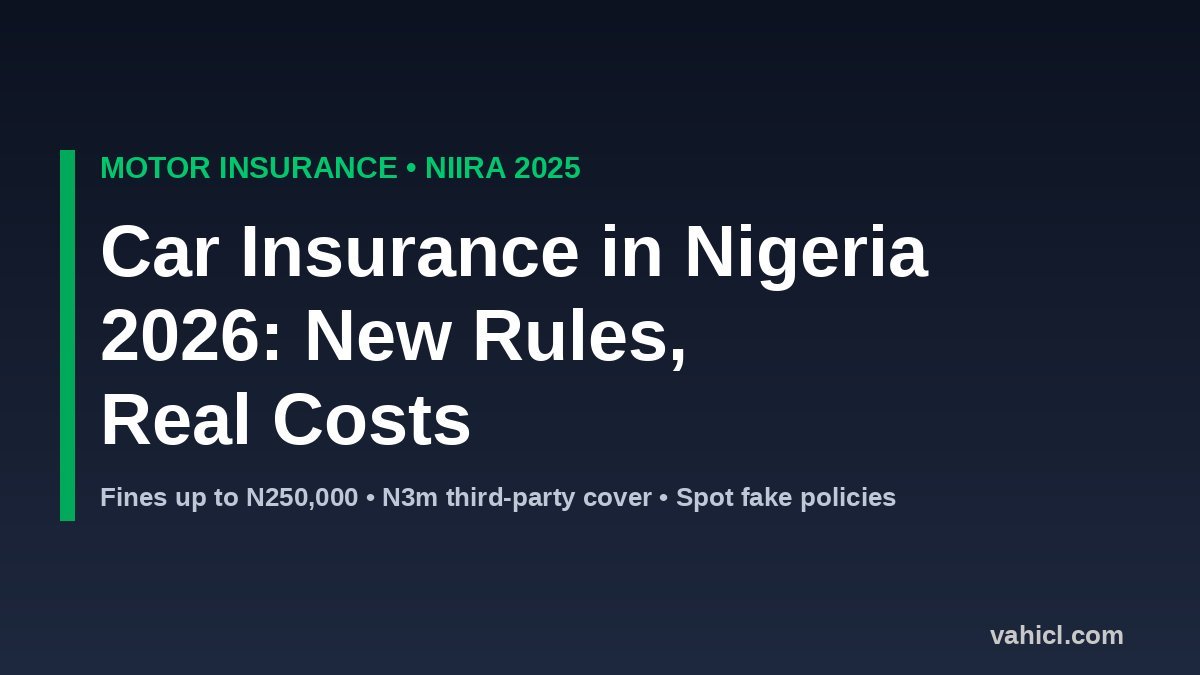
If you drive in Lagos, Abuja or Port Harcourt, motor insurance is one of those things most people only think about at a checkpoint. That is changing. The Nigerian Insurance Industry Reform Act 2025 (NIIRA 2025) replaced the old Insurance Act 2003 and the Motor Vehicles (Third Party Insurance) Act, NAICOM’s recapitalisation deadline closed on July 31, 2026, and regulators are now working with the FRSC to check insurance status in real time. For car owners, that means higher penalties for driving uninsured, broader cover on paper, and a much bigger risk if your “insurance” turns out to be a fake slip bought from a roadside tout.
This guide explains what the new rules say, what car insurance in Nigeria realistically costs in 2026, how to check that your policy is genuine, and how to choose between third-party and comprehensive cover.
What changed: NIIRA 2025 in plain English
President Bola Tinubu signed NIIRA 2025 into law in August 2025. According to legal analyses of the Act published by Nigerian law firms, the motor insurance provisions that matter most to everyday drivers are these:
- More people are responsible for insurance. The duty to insure is no longer only on the registered owner. It now extends to anyone with effective control or operational responsibility for the vehicle. That covers fleet managers, ride-hailing operators and, in practice, drivers who manage a car on someone else’s behalf.
- Much steeper penalties. Under the repealed law, the fine for driving uninsured was a token ₦100. NIIRA 2025 raises it to up to ₦250,000, up to six months’ imprisonment, or both, for a first conviction. For a repeat conviction, it rises to ₦500,000, up to 12 months, or both.
- Higher third-party limits. A compulsory policy must now cover third-party property damage of up to ₦3 million, as well as medical expenses for injured third parties: up to ₦100,000 for in-patients and up to ₦250,000 for out-patients. Damage to public property and road infrastructure is also brought within third-party cover.
- Passengers in commercial vehicles must be insured. Vehicles carrying passengers for hire or reward, including taxis, buses and e-hailing cars, must insure passengers against death or bodily injury, with minimum compensation of ₦2 million for death or total permanent disability.
- Electronic certificates are valid. When a law-enforcement officer asks for proof of insurance, you can now show a certificate or cover note in print or electronic form.
- ECOWAS Brown Card included automatically. Every motor policy issued in Nigeria now carries the ECOWAS Brown Card, so your third-party cover travels with you into other ECOWAS countries without a separate purchase.
- A fund for victims of uninsured drivers. The Act creates a Road Accident Victims Compensation Fund to help people hit by uninsured or unidentified drivers, including hospital treatment costs of up to ₦2 million per person, subject to review by NAICOM.
Why the recapitalisation deadline matters to motorists
NIIRA 2025 also raised the minimum capital insurers must hold. Non-life insurers, the companies that sell motor policies, now need at least ₦15 billion. NAICOM gave the industry 12 months to comply, ending July 31, 2026.
NAICOM published its first list of compliant firms in early August 2026. Seven more insurers were confirmed afterwards, bringing the total to 48 insurance companies and two reinsurers verified as meeting the new requirements, according to reports in the Nigerian business press.
For you as a policyholder, the practical point is simple: buy motor insurance only from a company on NAICOM’s current list of licensed, recapitalised insurers. A better-capitalised insurer is more likely to pay a claim. NIIRA 2025 also sets a 60-day limit for settling claims and penalises late payment. It also creates a Policyholders Protection Fund for cases where an insurer goes under.
How much does car insurance cost in Nigeria in 2026?
There are two main products. Their prices are set very differently.
1. Third-party motor insurance (the legal minimum)
Third-party insurance pays for damage or injury you cause to other people and their property. It does not repair your own car. The last NAICOM-approved tariff, in effect since January 2023 and widely reported at the time, set these annual premiums:
- Private cars: ₦15,000
- Commercial vehicles: ₦20,000
- Goods vehicles and staff buses: ₦20,000
- Trucks: ₦100,000
- Tricycles (keke): ₦5,000
- Motorcycles: ₦3,000
These figures came from the 2023 NAICOM tariff. We found no published 2026 revision in our research, but NAICOM can adjust rates, especially now that NIIRA has raised the cover limits. Confirm the current premium directly with a licensed insurer before you pay. Be suspicious of anyone offering “third party” far below the official rate.
2. Comprehensive motor insurance
Comprehensive cover includes third-party liability plus damage to your own vehicle from accidents, fire and theft. Many policies also offer extras such as flood cover, a courtesy car or towing. NAICOM’s guideline says the comprehensive premium must not be less than 5% of the sum insured after all rebates and discounts.
The sum insured is roughly what your car would cost to replace. With the floor at 5%, here is what the minimum looks like at typical Nigerian car values:
- ₦8 million tokunbo Corolla or similar: at least ₦400,000 a year
- ₦15 million used SUV: at least ₦750,000 a year
- ₦30 million newer SUV: at least ₦1.5 million a year
- ₦60 million brand-new vehicle: at least ₦3 million a year
These numbers are simple 5% calculations, not quotes. Your actual premium can be higher, depending on the insurer, the car’s age and model, where you live and drive, your claims history and any add-ons. Most comprehensive policies also carry an “excess”, the first part of any claim that you pay yourself. Ask for it in writing.
Third-party vs comprehensive at a glance
- Legal requirement: third-party is compulsory; comprehensive is optional, but lenders usually demand it for financed cars.
- Covers your own car: third-party, no; comprehensive, yes (accident, fire, theft).
- Third-party property damage: both include cover up to ₦3m under NIIRA 2025.
- Typical yearly cost (private car): third-party around ₦15,000 on the 2023 tariff; comprehensive at least 5% of the car’s value.
- Best for: third-party suits older, low-value cars; comprehensive suits newer, financed or high-value cars.
If you are buying a car on credit, for example through one of the options in our car loan in Nigeria guide, add comprehensive insurance to your monthly budget from day one. Lenders typically require it for the life of the loan.
Fake insurance is still a big problem
Fake motor insurance is a long-running issue in Nigeria. Industry data from the Nigerian Insurance Industry Database (NIID), reported by BusinessDay, once showed that only about 28% of 12 million registered vehicles had genuine cover on the system. The other 72% were uninsured or carried certificates from non-genuine sellers. NAICOM and the Nigeria Police have since run crackdowns on people selling fake policies.
The danger is not only a fine. If your policy is not on the NIID, your insurer has no record of you. If you hit another car, a pedestrian or a roadside shop, you will pay the whole bill yourself.
How to verify your car insurance in under a minute
- Use the NIID platform. Every licensed insurer must upload each motor policy it issues to the NIID. You can check your policy on the AskNIID platform or by USSD (*565*11# is the code cited by NAICOM and the FRSC). Enter your plate number or policy number as prompted.
- Check what comes back. A genuine policy shows the insurer’s name, your vehicle details and the expiry date. If the result says the policy is not on the database, treat the certificate as fake.
- Confirm the insurer is licensed. Check that the company is on NAICOM’s current list of licensed, recapitalised insurers.
- Buy direct or through a licensed broker. Pay the insurer, its official app or website, or a registered broker. Licensing offices and touts are not insurance companies.
- Keep a digital copy. NIIRA 2025 accepts electronic certificates, so save your certificate or cover note on your phone.
Enforcement: what to expect on the road
In late 2025, NAICOM and the FRSC set up a joint committee to enforce compulsory third-party motor insurance under NIIRA 2025. FRSC officers can now verify policies in real time through the NIID. Reports on the committee’s work say plans are at an advanced stage to link NAICOM’s systems with the FRSC’s National Vehicle Identification System and the Police Central Motor Registry. The aim is to flag uninsured vehicles automatically through cameras and patrols. Lagos has also used number-plate recognition to validate third-party insurance.
The direction is clear. Within the life of your next policy, a fake certificate that once got you past a checkpoint is increasingly likely to be caught electronically. The penalty is now up to ₦250,000 rather than ₦100.
How to cut your car insurance cost legally
- Get several quotes. Comprehensive premiums vary between insurers above the 5% floor. Compare at least three licensed companies.
- Insure for a realistic value. Over-insuring raises your premium. Under-insuring cuts what you get paid after a total loss. Use current market prices; tokunbo values have moved a lot with FX and the 2026 import duty changes.
- Ask about no-claim discounts if you have a clean record with your current insurer.
- Fit a tracker. Some insurers price theft risk lower for tracked vehicles. Ask before you buy one.
- Pick add-ons carefully. Flood cover makes sense in flood-prone parts of Lagos or Port Harcourt. A courtesy car may not be worth it if you have a second vehicle.
- Match cover to the car’s value. On an older, low-value runabout, such as some of the cheaper cars in our fuel-efficient tokunbo cars under ₦10m list, genuine third-party cover may be the sensible minimum. On a newer or financed car, comprehensive is usually worth it.
Honest drawbacks and open questions
- Claims experience still varies. NIIRA’s 60-day settlement rule is new, and real-world performance differs between insurers. Ask friends and mechanics which companies actually pay.
- Premium levels may change. The third-party premium was last set before NIIRA raised the medical and property limits. Watch for any NAICOM tariff update.
- Enforcement is uneven. Camera-based checking is still being rolled out, and checkpoint practice varies by state.
Key takeaways and FAQ
Key takeaway: Under NIIRA 2025, driving without genuine motor insurance can cost up to ₦250,000 for a first offence. Third-party cover now includes up to ₦3m property damage plus medical costs. For a private car it has been priced at ₦15,000 a year under the last published tariff. Always verify your policy on the NIID and buy only from a NAICOM-licensed insurer.
Is third-party insurance compulsory in Nigeria?
Yes. Every vehicle on a public road must have at least third-party cover. The only exemptions under NIIRA 2025 are military vehicles and certain foreign-government diplomatic vehicles.
How much is third-party insurance for a car in Nigeria?
The last NAICOM-approved rate, from January 2023, is ₦15,000 a year for private cars and ₦20,000 for commercial vehicles. Confirm the current price with your insurer.
How much is comprehensive car insurance in Nigeria?
At least 5% of the car’s insured value per year under NAICOM’s floor. For example, at least ₦500,000 on a ₦10 million car. Quotes can be higher.
Can I show my insurance on my phone?
Yes. NIIRA 2025 allows an electronic certificate or cover note when a law-enforcement officer asks.
Does my Nigerian policy cover me in Ghana or Benin?
Under NIIRA 2025, every Nigerian motor policy automatically includes the ECOWAS Brown Card for third-party liability within ECOWAS states. Confirm the details with your insurer before you travel.
Disclaimer: vehicle prices, insurance premiums, import duties and specs change frequently in Nigeria. Always confirm current figures with the dealer, your insurer or the official source (NAICOM, FRSC, NIID) before buying. This article is general information, not legal or financial advice.
Information in this article is based on the text of NIIRA 2025 as summarised by Nigerian legal practitioners, NAICOM announcements reported in the Nigerian press, and industry data from the Nigerian Insurance Industry Database.