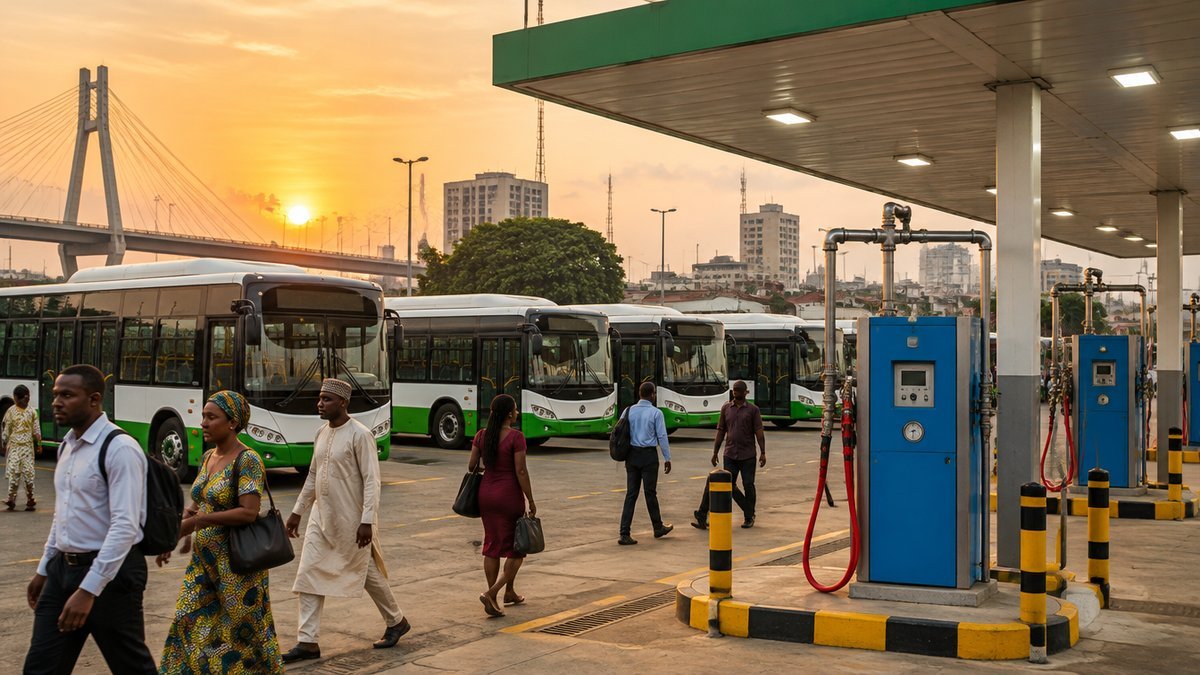
Nigeria’s push to move commuters from petrol and diesel onto gas has a big new name behind it. On Thursday, 19 November 2026, the Presidency announced that Yutong, the Chinese manufacturer widely described as the world’s largest bus maker, has reached an agreement with the Presidential Initiative on Compressed Natural Gas and Electric Vehicles (Pi-CNG & EV) to supply CNG buses and set up a bus assembly operation in Ibadan, Oyo State.
The headline numbers are simple: an initial 300 CNG-powered buses, the first 100 expected in Lagos by the end of December 2026, and later buses assembled locally at the former Leyland automotive plant in Ibadan. The government says the buses will feed the National Affordable CNG Transit Programme, which targets fare cuts of around 40% on participating routes.
For the average commuter in Lagos, Ibadan or Abuja, and for transport operators weighing their next fleet purchase, the real questions are practical. When will these buses actually be on the road? Will fares really fall? And what does an assembly plant in Ibadan mean for jobs, spare parts and the wider CNG economy? Here is what has been announced, what has not, and how to read it.
What Was Announced: The Key Facts
The details come from a statement issued by Bayo Onanuga, Special Adviser to the President on Information and Strategy, and were reported by several Nigerian outlets including BusinessDay, Voice of Nigeria and Legit.ng. Here is the core of the deal as reported:
- Manufacturer: Yutong, which sold 49,518 buses globally in 2025, according to the Presidency’s statement.
- Nigerian counterparty: the Presidential Initiative on Compressed Natural Gas and Electric Vehicles (Pi-CNG & EV), the body that grew out of the Presidential CNG Initiative launched after the 2023 petrol subsidy removal.
- First order: an initial 300 CNG buses.
- First delivery: 100 buses expected in Lagos by the end of December 2026.
- Local assembly: subsequent buses to be assembled through YP Automobiles Bus Assembly at the former Leyland Automotive plant in Ibadan, Oyo State.
- Programme: the National Affordable CNG Transit Programme (NACTP), run with state governments.
- Fare target: roughly 40% lower fares on participating routes, framed as part of the administration’s 2027–2031 agenda.
- Refuelling: Mobile Refuelling Units plus a presidential directive for additional CNG refuelling units nationwide, with the Midstream and Downstream Gas Infrastructure Fund (MDGIF) and private investors involved.
One point worth flagging: reports differ slightly on the details. BusinessDay reported that the agreement was scheduled to be signed in Lagos on 19 November, while other outlets describe it as an agreement Yutong “plans” to act on. Most reports put the refuelling directive at 2,000 additional units, but at least one outlet reported 1,000. Until a formal signing document or delivery confirmation is published, treat the timeline as a stated target rather than a done deal.
Why an Ibadan Assembly Plant Matters
Importing fully built buses is expensive for Nigeria. Every unit shipped in carries freight, port charges and clearing costs, and it pulls on scarce foreign exchange. Local assembly, even at the semi-knocked-down stage, changes that equation in a few ways.
1. Reviving an old automotive site
The former Leyland plant in Ibadan is a legacy of Nigeria’s earlier era of vehicle assembly, and the Presidency says the deal aims to revive that capacity. Bringing it back into use gives the South-West a working automotive facility again and fits with the government’s broader push for local vehicle assembly in Nigeria.
2. Jobs for engineers and technicians
The Presidency says the plant will create jobs for Nigerian engineers, technicians and factory workers. No job figure has been published yet, so be cautious of any specific number you see quoted on social media.
3. Spare parts and after-sales
This is the part that often decides whether a bus fleet survives in Nigeria. Many past mass-transit schemes failed not because the buses were bad, but because parts were hard to get and maintenance was weak. A local assembly line usually brings a parts warehouse, trained technicians and a service network with it. If that happens here, CNG buses will be far easier to keep on the road than imported units that depend on overseas parts orders.
4. Less pressure on FX
Fewer fully built imports means less dollar demand per bus. Nigeria’s vehicle import bill has climbed sharply this year: Nairametrics’ analysis of National Bureau of Statistics data put passenger car imports at about ₦1.18 trillion in the first half of 2026, up roughly 146% on the same period of 2025. Local assembly of buses won’t fix that on its own, but it is a step in the right direction.
Will Transport Fares Really Drop 40%?
This is the question most Nigerians care about. The honest answer: the 40% figure is a target for participating routes, not a nationwide promise.
Here is why CNG buses can, in principle, run cheaper than diesel or petrol buses:
- Cheaper fuel per kilometre. CNG has generally cost less per kilometre than petrol or diesel in Nigeria, which is the main reason operators convert. Check current CNG and pump prices, as both move.
- Government support. Under the federal CNG push, the government waived import duties on EVs and mass-transit buses in April 2026, and state governors agreed to use CNG and electric vehicles to cut transport fares from 1 October 2026.
- Fleet scale. Larger, standardised fleets are cheaper to maintain per bus than mixed fleets of old vehicles.
There are already early examples. In remarks reported by Pan African Visions, President Tinubu cited CNG bus fares of ₦1,600 on the Enugu–Nsukka route, down from as much as ₦4,000, plus ₦50 rides in Borno and a free CNG bus service in Kaduna. These are specific participating services, though, not the normal fare on every route in those states.
Several factors will decide whether you personally see cheaper fares:
- Which routes get the buses. Only designated routes run by participating operators qualify for programme fares. No route list for the Yutong buses has been published yet.
- Refuelling access. A CNG bus is only as useful as the nearest gas station. Lagos has been adding stations (we covered the new Lagos CNG stations recently), but coverage outside major cities is still thin.
- Operator economics. Fares depend on how the buses are financed, what operators pay to lease or buy them, and their running costs. Legit.ng noted that actual savings will depend on deployment, operating costs and the operators involved.
- Petrol prices. Petrol has been easing: Dangote Refinery cut its depot price to ₦1,105 per litre around 20 November, its second cut in three days. If petrol keeps falling, the fare gap between CNG and petrol-powered danfos and korope buses may narrow.
For a deeper look at how earlier fare cuts have played out, see our breakdown of whether CNG transport is really cheaper.
How This Fits Nigeria’s Wider Bus Picture
Yutong is not new to Nigeria. Earlier this month, Oando Clean Energy and LAMATA launched a fleet of Yutong electric buses in Lagos, which we covered in what Oando’s electric bus rollout means. The new deal is different: it is about CNG buses, a federal programme, and an assembly base in Ibadan rather than Lagos.
Here is a quick comparison of the main mass-transit options now in play:
- CNG buses (Yutong / NACTP): lower fuel cost than diesel, relies on CNG station coverage, federal programme backing, local assembly planned in Ibadan.
- Electric buses (Oando / LAMATA in Lagos): lowest running cost per kilometre where power is reliable, needs depot charging and stable electricity, higher upfront cost.
- Diesel BRT and franchise buses: proven and widely serviceable, but exposed to diesel price swings and higher emissions.
- Petrol danfo and korope minibuses: flexible and everywhere, but most exposed to petrol prices; many are candidates for CNG conversion.
Pan African Visions reported that CNG transit programmes are already running in at least ten states and the FCT, and that several state governments have recently accelerated CNG bus procurement. The Yutong deal adds scale and, crucially, a local assembly base.
What It Means for Transport Operators and Investors
If you run a fleet, a transport cooperative or a park, this announcement is worth watching closely:
- Financing terms: no bus price, lease rate or financing scheme for operators has been published. Wait for official terms before making commitments, and be wary of anyone “selling slots” on the programme.
- Route allocation: participation usually runs through state governments and their transport agencies. Keep in touch with your state ministry of transport or transport authority.
- Refuelling plans: if you are planning a CNG fleet, map your routes against existing and planned CNG stations before committing.
- Conversion vs new buses: for smaller operators, converting existing petrol buses may remain cheaper than buying new. Our guide to CNG conversion cost in Nigeria breaks down the numbers.
The Honest Drawbacks and Open Questions
It is a promising announcement, but there are real gaps:
- No published price or contract value. We don’t know what each bus costs or who ultimately pays.
- No assembly start date. The Ibadan plant has no confirmed date for its first locally assembled bus, and no stated production capacity.
- No route list. Commuters can’t yet tell whether their daily route will benefit.
- Refuelling is the bottleneck. Nairametrics has reported that the government fell short of its 2025 CNG infrastructure targets; scaling buses faster than gas stations would strand vehicles.
- Delivery timing. 100 buses in Lagos by end of December is a tight window. Slippage would not be unusual.
- Maintenance culture. Past public bus schemes have collapsed under poor maintenance. Strong after-sales support will matter as much as the buses themselves.
Key Takeaways
Yutong’s agreement with Pi-CNG & EV is one of the more concrete steps in Nigeria’s CNG transport push: 300 buses, the first 100 due in Lagos by end of December 2026, and local assembly planned at the old Leyland plant in Ibadan. The 40% fare cut is a target for participating routes only, and real savings will depend on route allocation, refuelling access and operator costs.
FAQ
When will the Yutong CNG buses arrive in Nigeria?
The Presidency says the first 100 are expected in Lagos by the end of December 2026. Later buses will be assembled in Ibadan, with no confirmed start date yet.
Will all bus fares in Nigeria drop by 40%?
No. The roughly 40% cut is a target for participating routes under the National Affordable CNG Transit Programme, not a nationwide fare cut.
Can I buy a Yutong CNG bus as a private operator?
No public pricing or operator purchase scheme has been announced. Check with your state transport ministry or official Pi-CNG & EV channels for updates.
Where will the buses be assembled?
At the former Leyland Automotive plant in Ibadan, Oyo State, through YP Automobiles Bus Assembly.
Information in this article is based on the Presidency’s 19 November 2026 statement as reported by BusinessDay, Voice of Nigeria, Legit.ng and Pan African Visions, and on NBS trade data as analysed by Nairametrics.
Vehicle prices, import duties and specs change frequently in Nigeria — always confirm current figures with the dealer or official source before buying.