
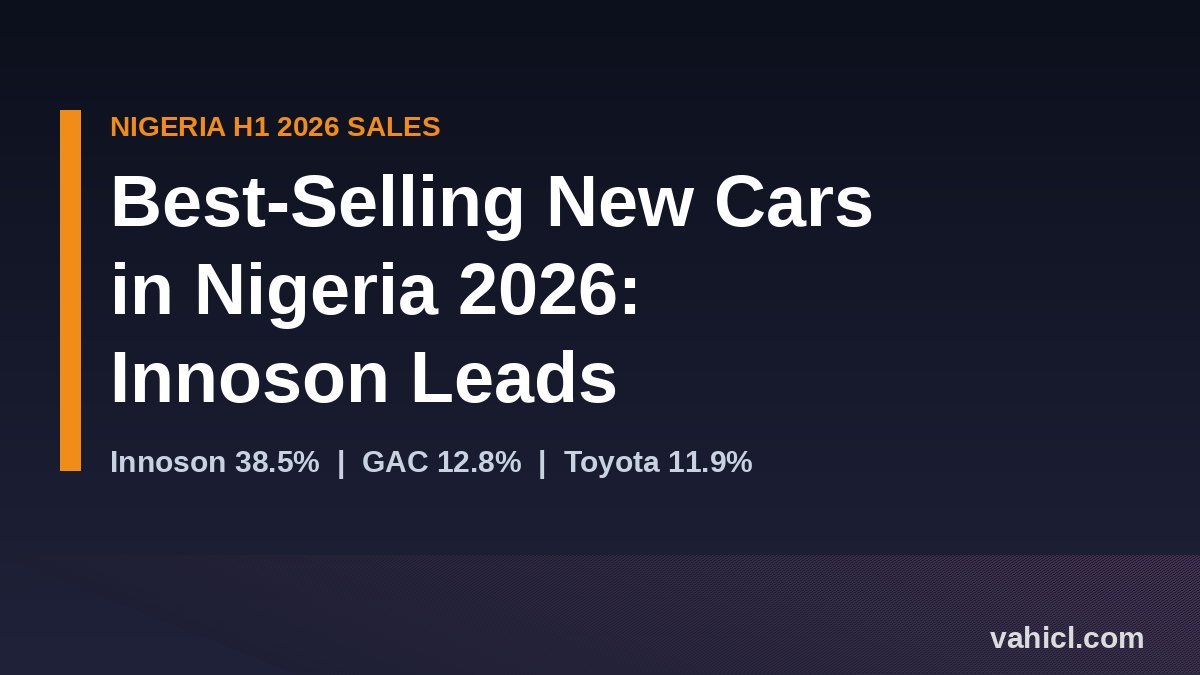
Nigeria’s brand-new car market is having its best year in a long time, and the names at the top of the sales chart may surprise anyone who still assumes Toyota owns the showroom. According to first-half 2026 data compiled by the market tracker Focus2move, new vehicle sales in Nigeria reached 16,889 units in H1 2026, up 85.2% on the same period last year. Locally built Innoson took the brand crown by a wide margin, Chinese marque GAC jumped into second place, and Toyota slipped to third.
If you are weighing a brand-new car against a tokunbo, or trying to work out which brands have the dealer network and parts support to be a safe bet, these numbers tell you a lot about where the market is heading. Here is what the figures say, what the best-sellers cost, and what it means for your next purchase.
The H1 2026 Leaderboard: Brands
Per Focus2move’s first-half figures, the top three brands by share of new vehicle sales were:
- Innoson (IVM) – 38.5% market share, with sales up 111% year-on-year.
- GAC Motor – 12.8% share, after climbing eight places in the brand ranking.
- Toyota – 11.9% share, with sales up 18.1%.
Put simply, more than one in three brand-new vehicles sold in Nigeria in the first half of the year carried an Innoson badge. Toyota still grew, but nowhere near as fast as the market itself, which is why it lost ground.
The H1 2026 Leaderboard: Models
At model level the picture is a mix of the old guard and the home team:
- Toyota Hilux – No. 1 with a 7.5% share, up 27.8%.
- Innoson Connect – No. 2 with a 6.2% share.
- Innoson Seriki – No. 3 with a 5.9% share.
The Hilux’s position makes sense. It remains the default choice for companies, government agencies, oil-and-gas contractors and anyone who needs a tough pickup for rough roads outside the big cities. The Innoson Connect, a compact passenger model, and the Seriki, a bus, show how strongly Innoson has pushed into both private and commercial segments.
Why Local and Chinese Brands Are Winning
1. Duty structure favours local assembly
The single biggest reason is cost. Speaking to BusinessDay in April 2026, Muda Yusuf of the Centre for the Promotion of Private Enterprise noted that completely knocked down (CKD) kits remain at zero percent duty, while semi knocked down (SKD) kits attract about 10%. Fully built imports pay far more once levies, VAT and port charges are stacked on top. That gap gives brands that assemble in Nigeria, like Innoson, and those with local assembly partners, a real price advantage on the showroom floor.
2. Government and fleet buying
Nigeria’s push for local patronage, including the “Nigeria First” policy direction and the Local Automotive Industry Patronage Bill that passed second reading in 2025, nudges ministries and agencies towards made-in-Nigeria vehicles. Fleet and government orders can move volumes quickly in a market this small, and Innoson’s buses and pickups are well positioned for them.
3. Chinese brands are pricing aggressively
GAC’s climb is the other big story. Its Nigerian distributor, CIG Motors, ran an “Ember Price Slash” campaign from November to December 2025 that, according to a ThisDay report, advertised the GAC GS3 compact SUV from ₦25 million, the Wuling Bingo EV from ₦25 million, the Aion Y electric SUV at ₦35 million and the Wuling N1111 van from ₦10 million. That promotion has ended, but it shows the pricing strategy: undercut Japanese rivals on sticker price while offering more features per Naira.
4. Toyota is expensive brand-new
Brand-new Toyotas have drifted far out of reach for most private buyers. Current dealer and marketplace listings for a new 2026 Hilux run roughly from ₦55 million to well above ₦100 million depending on trim, engine and 4×2 vs 4×4. Toyota’s strength in Nigeria has always been in the used market, and many buyers who want a Toyota simply go tokunbo instead.
What the Best-Sellers Cost (Estimated Ranges)
Nigerian new-car prices move with the exchange rate, so treat these as rough guides drawn from recent dealer listings and price trackers, not fixed quotes:
- Toyota Hilux (2026, brand new): roughly ₦55m – ₦120m depending on variant. Top-spec 4×4 models sit at the upper end.
- Innoson Connect: online price guides quote widely different figures, from single-digit millions to the high teens of millions. The spread likely reflects different trims and dates, so request a current quote directly from an Innoson dealer.
- Innoson Seriki (bus): pricing is not widely published; it is mostly sold to fleet and commercial buyers on quotation.
- GAC GS3 / Emzoom: CIG Motors’ late-2025 promo price was from ₦25m; current estimates on Nigerian price sites for the 2026 GS3 Emzoom sit around the low-to-high ₦30 millions.
For context, BusinessDay reported in April 2026 that brand-new sedans like the Toyota Corolla were starting at around ₦18 million to ₦35 million in early 2026, while SUVs ranged from ₦25 million to over ₦120 million. Prices quoted by other sources are higher still, which tells you how fast quotes go stale.
New vs Tokunbo: Does This Change the Maths?
Even at 16,889 units for six months, the new-car market is tiny for a country of more than 200 million people. The used market is where most Nigerians actually buy, and imports of foreign-used cars have surged this year as well. We broke that down in our piece on tokunbo car imports hitting ₦1.18trn.
Here is how the trade-off looks in 2026:
- Brand new (local or Chinese brand): full warranty, known history, often easier financing through dealer and bank partnerships. Downside: faster depreciation and less certainty about resale value for newer brands.
- Brand new Toyota: best resale value and widest mechanic familiarity, but the price premium is now huge.
- Tokunbo: lowest entry price for a known badge, cheap and plentiful parts for popular models at markets like Ladipo. Downside: unknown history, accident damage risk and import-related surprises.
Running Costs and Spare Parts
Purchase price is only half the story. Before you commit to any of the best-sellers, think about the next five years:
- Parts availability: Toyota parts are everywhere, genuine and aftermarket. Innoson and GAC parts come mainly through their own dealer networks, so check how close the nearest service centre is to you in Lagos, Abuja, Port Harcourt or wherever you live.
- Fuel economy: with petrol prices still a major monthly cost, smaller-engined compact SUVs and sedans are easier to live with than a big diesel pickup. If fuel is your main concern, also look at our guide to CNG conversion costs in 2026.
- Insurance: comprehensive car insurance in Nigeria is priced as a percentage of the vehicle’s value, so a ₦90m Hilux costs far more to insure than a ₦30m compact SUV.
- Resale: newer Chinese brands are still building a used-market track record. Expect steeper depreciation than a Toyota for now.
Honest Drawbacks to Keep in Mind
- Market share figures from a small base can swing sharply; a few large fleet orders can push a brand up the chart in one half-year.
- Focus2move’s figures track new vehicle sales reported through the formal market; they do not capture the far larger tokunbo trade.
- Dealer service quality varies by city. A strong brand ranking nationally does not guarantee good after-sales support in your state.
Buying Checklist
- Get a written, dated quote from an authorised dealer and ask how long it is valid.
- Confirm the warranty terms (years and kilometres) and what voids them.
- Ask where the nearest authorised service centre is and the cost of the first three services.
- Compare car loan options from the dealer’s partner banks against your own bank.
- Buy only from a registered dealer; see our explainer on NADDC dealer registration.
Key Takeaways
Nigeria’s new car sales rose 85.2% to 16,889 units in H1 2026. Innoson leads with a 38.5% share, GAC is a surprise second at 12.8%, and Toyota is third at 11.9%, though the Toyota Hilux remains the single best-selling model. Lower duties on locally assembled kits and aggressive Chinese pricing are reshaping the showroom, but brand-new prices are still volatile, so always get a fresh quote before you budget.
FAQ
What is the best-selling car brand in Nigeria in 2026?
Based on Focus2move’s H1 2026 data, Innoson, with 38.5% of new vehicle sales.
What is the best-selling car model in Nigeria?
The Toyota Hilux, with a 7.5% share of new sales in the first half of 2026.
Are Chinese cars a good buy in Nigeria?
They often offer more features for the money and GAC’s growth shows buyer confidence is rising. The trade-offs are a shorter resale track record and a reliance on dealer networks for parts.
Disclaimer: vehicle prices, import duties and specs change frequently in Nigeria — always confirm current figures with the dealer or official source before buying.
Sales figures per Focus2move H1 2026 data; duty and pricing context per BusinessDay and ThisDay reporting.




1 thought on “Best-Selling New Cars in Nigeria 2026: Innoson Leads”