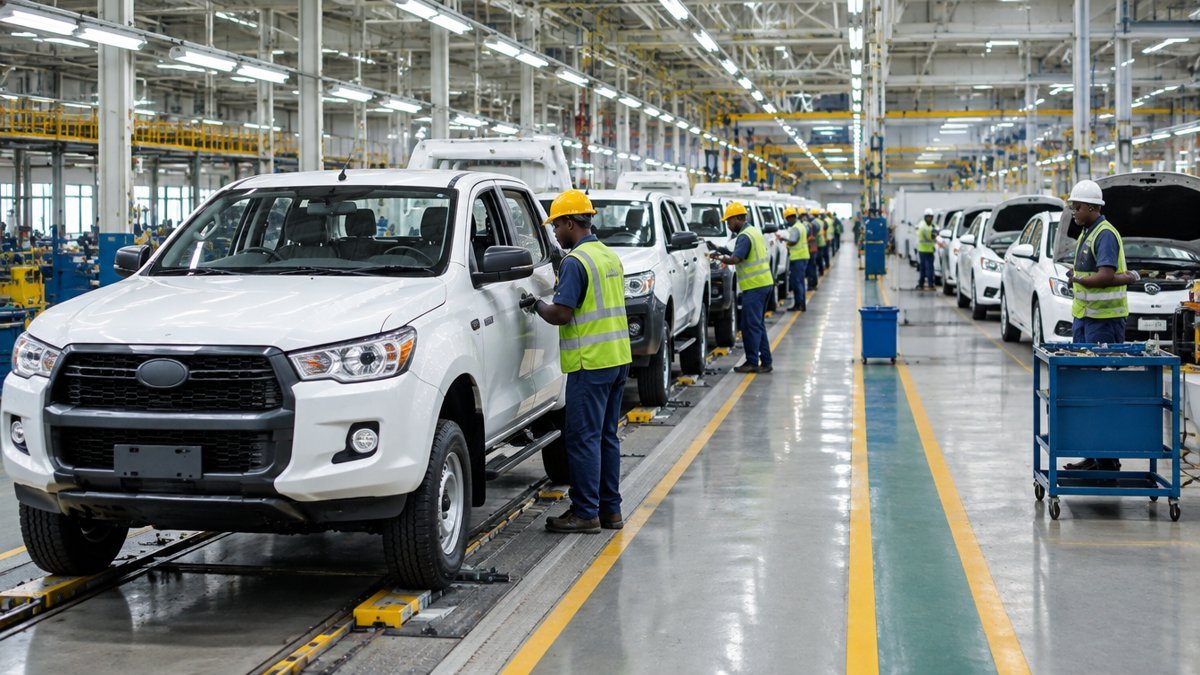
Nigeria’s federal government has just changed the rules for how it buys vehicles. Under the Nigeria First Policy, ministries, departments and agencies (MDAs) are now expected to buy their vehicles from licensed local assemblers, not from foreign suppliers. The announcement, made in Abuja in the second week of October 2026, matters well beyond government fleets. It touches new car prices in Nigeria, spare parts supply, local jobs and the long-running debate about whether imported or locally assembled cars are the better buy.
Here is what was actually announced, what the numbers say, and what it could mean if you are shopping for a car in Nigeria.
What the Nigeria First vehicle procurement rule says
According to reports from Channels Television, Tribune Online and Voice of Nigeria, the Director-General of the National Automotive Design and Development Council (NADDC), Oluwemimo Joseph Osanipin, and the Director-General of the Bureau of Public Procurement (BPP), Dr Adebowale Adedokun, laid out the framework at a press conference in Abuja around 9 October 2026.
- Local assemblers first: MDAs must source the vehicles they procure, including project utility vehicles, from licensed local assemblers or their authorised retailers.
- Foreign purchases only by exception: a government agency can buy a foreign-assembled vehicle only if it can show that no domestic alternative exists and obtains direct presidential clearance.
- Traceable VINs: every vehicle supplied to government must carry a traceable Vehicle Identification Number verified through the NADDC.
- Sanctions: the NADDC said supplies from outside licensed local assembly lines will attract regulatory sanctions, including blacklisting and licence revocation.
- Quality expectations: the BPP warned that poor quality, weak after-sales support and policy violations by manufacturers can also bring sanctions.
The reports did not name specific assemblers or give an effective date. The BPP said it is still developing an institutional framework, standard policies and a circular to guide implementation across government bodies, following a directive from President Bola Tinubu. So treat this as a policy that is being rolled out, not one that has fully taken effect overnight.
The numbers behind the policy
Several figures were quoted at the briefing, according to Voice of Nigeria and Channels Television:
- Nigeria’s assembly plants have a combined annual capacity of about 370,520 vehicles, per the NADDC.
- The policy sets an annual vehicle procurement target of 3 million units, with around 80 percent to be produced by local assemblers.
- Under the African Continental Free Trade Area (AfCFTA), Nigerian manufacturers must show about 40 percent local content to sell across Africa tariff-free.
- The BPP DG said that in one federal procurement exercise, the price of a vehicle fell from about N72 million to N35 million.
That last figure is a claim from an official, not an independent audit, and it relates to a specific procurement, not the retail market. Still, it signals what government is hoping for: lower unit costs when procurement shifts to local assembly.
From SKD to CKD: why assembly type matters
Most local assemblers in Nigeria currently work with Semi Knocked Down (SKD) kits, where large sub-assemblies arrive pre-built and are put together locally. The NADDC says it wants assemblers to graduate to Completely Knocked Down (CKD) production, where more parts arrive separately and more of the work, and more of the local content, happens in Nigeria.
For buyers, this shift is the part to watch. More local content generally means more potential for local spare parts, local servicing skills and, over time, less exposure to exchange-rate swings. Whether that actually shows up in showroom prices depends on volume, factory efficiency and the naira.
What this could mean for car buyers in Nigeria
1. Locally assembled cars may become easier to find
Guaranteed government demand gives assemblers the confidence to produce at higher volumes. That could mean more dealer stock and more model choice from local plants. Brands that assemble in Nigeria, such as Innoson Motors and others licensed by the NADDC, stand to benefit most.
2. Spare parts and servicing could improve
One of the biggest worries when buying a new car in Nigeria is what happens after the warranty: can you get parts, and is there a competent mechanic? The NADDC and BPP both say sustained government patronage should create demand for local components and maintenance services. If that happens, owners of locally assembled vehicles may see shorter waits and lower costs. It is a hope, not a guarantee.
3. Imports are not banned for private buyers
This rule applies to government procurement. It does not stop you from buying a tokunbo or importing a car, and nothing in the reports changes the import duty on cars in Nigeria for private buyers. Foreign-used cars remain a large part of the market, and they remain subject to the usual duty and clearing costs. Check our guides on tokunbo imports and EV import duty for those details.
4. Prices may move, but not instantly
If local assemblers scale up, unit costs could fall. But vehicle pricing in Nigeria is also driven by FX, component imports and logistics. Do not expect retail prices to drop the week a circular is issued. Expect a slower, model-by-model effect, if any.
Who benefits, and who might lose out
- Local assemblers and parts makers: a predictable government customer and a push toward higher local content.
- Technicians and factory workers: the policy is pitched as a job creator, especially for skilled workers and young Nigerians.
- Foreign-vehicle suppliers to government: they face tighter rules, VIN verification and possible blacklisting.
- Taxpayers: they benefit if lower procurement costs are real, and if quality holds up.
The honest drawbacks and open questions
Industry voices were positive. The Chairman of the Nigeria Automotive Manufacturers Association, Bawo Omagbitse, said the policy could reduce investment risk and speed up local content development, and he pointed out that policy instability has put off some investors in a capital-intensive sector. But several questions remain open:
- Quality and after-sales: the BPP itself warned manufacturers about this. Buyers will judge local brands on reliability and service, not on policy.
- Capacity versus target: a 3 million-unit procurement target sits against a stated plant capacity of about 370,520 vehicles a year. The gap suggests the targets are aspirational for now.
- Timeline: no effective date or detailed circular had been reported at the time of writing.
- Price pass-through: falling government unit costs do not automatically reach private buyers.
Should you buy a locally assembled car now?
If you are comparing a locally assembled new car with a tokunbo import, the policy does not change the basic maths. Compare the total cost of ownership: purchase price, insurance, fuel economy, parts availability near you in Lagos, Abuja or Port Harcourt, and resale value. If you plan to finance, compare offers in our car loan Nigeria guide, since interest rates can matter as much as the sticker price.
Practical steps before buying either type of car:
- Ask the dealer for the vehicle’s VIN and confirm the assembler is licensed by the NADDC.
- Get a written quote for the car, registration and insurance.
- Ask where the nearest authorised service centre is and what common parts cost.
- For a tokunbo, request customs documents and check clearing costs against the current tariff.
- Compare at least two or three options before paying a deposit.
Key takeaways and FAQ
Key takeaway: the Nigeria First Policy directs government agencies to buy locally assembled vehicles, with foreign purchases allowed only by exception and presidential clearance. It is a government-procurement rule, not a ban on private imports, and its effect on retail prices is still unproven.
Does this ban tokunbo cars? No. The reports describe government procurement rules. Private buyers can still import or buy foreign-used cars, subject to the usual duties.
Will local cars get cheaper? Possibly over time if volumes grow, but prices also depend on exchange rates and imported components. Confirm current prices with dealers.
What is the difference between SKD and CKD? SKD kits arrive mostly assembled in large sections, while CKD kits arrive as separate parts, which means more local assembly work and more local content.
Who enforces the rule? The NADDC and the BPP, which say they will monitor patronage, standards compliance and manufacturers’ investment, employment and production growth.
Disclaimer: vehicle prices, import duties and specs change frequently in Nigeria. Always confirm current figures with the dealer or the official source before buying. Policy details were reported by Channels Television, Tribune Online and Voice of Nigeria in October 2026 and may be updated by the NADDC and BPP.