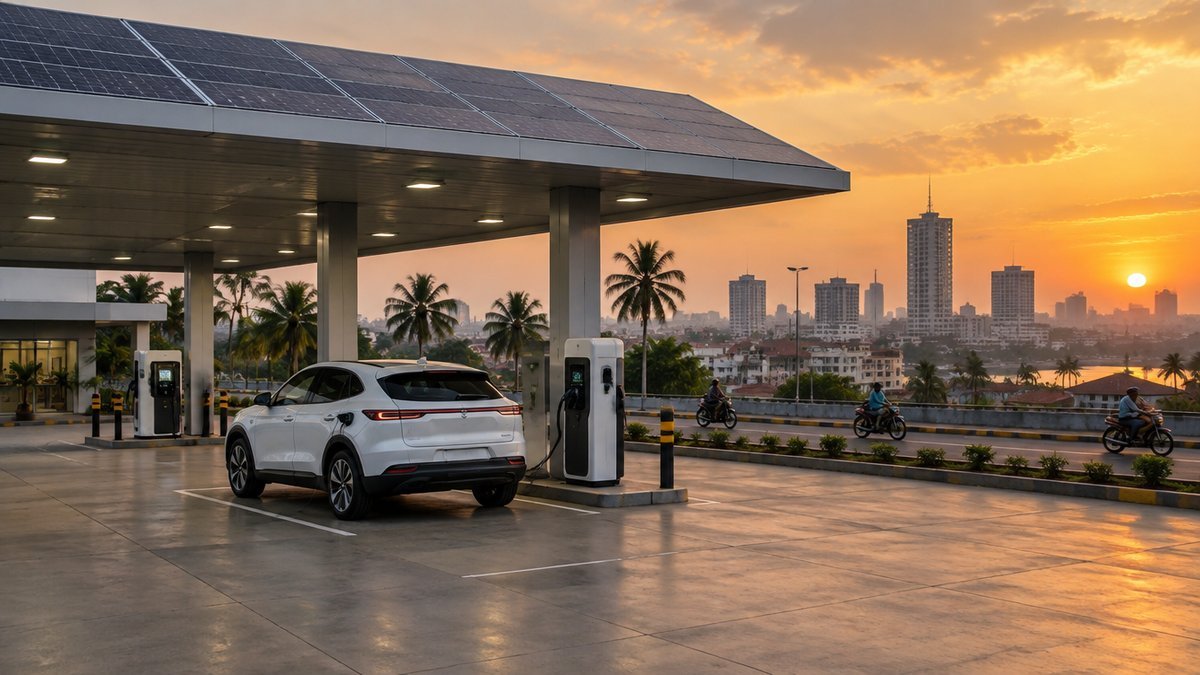
For years the honest answer to “can I really own an electric car in Nigeria?” has been a question of its own: where exactly are you going to charge it? That answer just got slightly better. On Thursday, 10 September 2026, NNPC Retail commissioned its first smart, self-service filling station in Abuja — and it came with six electric vehicle charging points, powered entirely by solar.
Four days later, on 14 September, the energy transition think tank RMI published a report titled “Developing Nigeria’s Charging Infrastructure”, warning that the country will need a far bigger charging and battery-swapping network to keep up with EV demand that is already building. Put those two stories side by side and you get a fair picture of where electric car charging in Nigeria actually stands in 2026: real progress, from a very small base.
What NNPC Actually Built in Abuja
The station sits along Bill Clinton Drive on Airport Road, between the Flight Training School and the Nigerian Immigration Service headquarters. It is not a token EV pilot bolted onto a normal filling station — it is a full retail site designed around automation.
- 180,000 litres of Premium Motor Spirit (petrol) storage capacity
- 45,000 litres of Automotive Gas Oil (diesel) capacity
- 16 pumps for petrol and 2 pumps for diesel
- Six EV charging points, installed in partnership with African Motor Works
- LPG (cooking gas) dispensing
- Automated car wash and a vehicle service facility
- Self-service fuel dispensing — you pay at the pump rather than through an attendant
- Powered entirely by solar, from a system rated at more than 200 kilowatts
That last point is the one that matters most for EV owners. A charging point tied to the national grid inherits every problem the grid has. A charging point running off a 200kW+ solar array does not care whether there is light in the area that afternoon. For a country where “no light” is a daily planning assumption, solar-backed public charging is not a green gimmick — it is the only version of public charging that can be relied on.
NNPCL has said it intends to deploy between 50 and 70 of these smart, self-service stations nationwide within the next six months. If even half of them carry EV charging points at the same six-point density, that would meaningfully change the national map — from a handful of chargers clustered in Lagos to something resembling a corridor network.
Where You Can Actually Charge Today
Be clear-eyed about the current base. Lagos, the most EV-dense city in the country, had roughly 22 confirmed public charging stations in 2026. The largest single network belongs to MAX, with about 16 sites spread across Lekki, Ajah, Ikoyi, Ikeja, Yaba, Surulere, Egbeda and Alapere. Qoray Mobility runs a handful more, including 60kW DC fast chargers sited at hotels in Ikeja.
Abuja and Port Harcourt have far less. Outside the three big cities, public charging is effectively not a thing yet — which is why almost every Nigerian EV owner today charges at home, at night, off their own meter or their own solar and inverter setup.
The two-wheeler story is different
RMI’s report makes a point worth repeating: the fastest-moving part of Nigeria’s electric transition is not cars, it is two- and three-wheelers, and their infrastructure need is battery swapping, not charging. A delivery rider cannot sit for 90 minutes while a battery fills. Swap stations, where a depleted pack is exchanged for a charged one in two minutes, fit commercial riding economics far better. RMI estimated roughly 20,000 electric vehicles on Nigerian roads in 2025 across all segments, with swapping demand concentrated in the bike fleet.
What It Costs to Charge an EV in Nigeria
This is where EVs still win, and win comfortably — but the size of the win depends entirely on where your electricity comes from. The figures below are estimates for illustration, based on an electric car using about 18 kWh per 100km and a petrol car using about 10 litres per 100km. Your own numbers will vary with driving style, traffic and vehicle.
- Home charging, Band A tariff (around ₦209.50/kWh on Eko Disco in September 2026): roughly ₦3,770 per 100km
- Home charging, lower band tariff (around ₦61/kWh): roughly ₦1,100 per 100km
- Public fast charging (commonly quoted at ₦150–₦300/kWh): roughly ₦2,700–₦5,400 per 100km
- Solar charging, amortised over the life of the system (often estimated near ₦20/kWh): roughly ₦360 per 100km
- Petrol, at recent pump prices near ₦1,395 per litre: roughly ₦13,950 per 100km
Even on the most expensive realistic option — a Band A tariff — charging costs something in the region of a quarter of what petrol costs for the same distance. On solar, the gap becomes almost absurd. That single line is the entire commercial case for EVs in Nigeria, and it is why the running-cost argument survives even when the purchase price does not.
Average electricity tariffs across bands sit somewhere between ₦150 and ₦230 per kWh, so most urban drivers will land closer to the first scenario than the second. Note also that public fast charging is priced at a premium because operators are covering diesel backup, land, hardware and downtime — expect it to stay more expensive than home charging for years.
The Policy Picture Behind the Chargers
Charging infrastructure does not appear on its own. It follows vehicles, and vehicles follow duty policy. On that front, 2026 has been unusually favourable:
- About 4,000 electric vehicles were imported into Nigeria in the first half of 2026.
- The federal government approved tax waivers on those imports, with import duty reduced to zero under a clean mobility programme aimed at boosting adoption and local assembly.
- EVs were exempted from the standard 7.5% VAT back in 2024.
- The National Automotive Industry Development Plan (2023–2033) targets a 30% local EV production share and 40% local content.
- The Ministry of Industry, Trade and Investment signed a memorandum with South Korea’s Asian Economic Development Committee to build an EV assembly plant in Kano, with a stated annual capacity of 300,000 vehicles.
- The NADDC is working alongside the Presidential Initiative on CNG and EVs to align policy across both alternative-fuel routes.
Analysts project Nigeria’s EV charging station market will grow at about a 27.4% compound annual rate through 2035. Treat long-horizon market forecasts as direction, not gospel — but the direction is not in dispute.
Honest Drawbacks You Should Weigh
None of this makes an EV the obvious buy for every Nigerian driver. Be realistic about the following:
- Purchase price. Duty waivers reduce landed cost, but electric cars still cost more upfront than a comparable tokunbo petrol saloon. The savings arrive over years of driving, not at the dealership.
- Charging outside the big three cities. If your regular route includes long interstate runs, public charging cannot yet support you. Plan around home charging or don’t buy yet.
- Grid dependency. Without solar or a substantial inverter and battery setup, your “cheap fuel” is only as reliable as your DisCo.
- Spare parts and technicians. The mechanic ecosystem for EVs is thin. A fault that would be a two-hour fix on a Corolla can mean waiting weeks for a part.
- Resale uncertainty. The Nigerian used-EV market is young, and battery health is hard for the average buyer to verify. Resale values are unpredictable.
- Insurance. Comprehensive cover on a high-value EV will cost more than on an equivalent petrol car.
Key Takeaways
If you are considering an electric car in Nigeria right now, here is the short version:
- Charging is getting better, from a low base. NNPC’s Abuja station adds six solar-powered charging points, and 50–70 more smart stations are planned nationwide within six months.
- Solar is the real unlock. Solar-backed charging removes the grid from the equation and cuts per-kilometre cost to a fraction of petrol.
- Home charging remains the default. Public charging in Nigeria is a convenience, not a foundation. Buy an EV only if you can charge where you park.
- Duty waivers are live now. Zero import duty and the VAT exemption meaningfully reduce landed cost — confirm the current position with a clearing agent before you commit.
- Bikes will electrify before cars. Battery swapping, not charging, is what the commercial two-wheeler fleet needs, and that is where volume adoption will show up first.
- Petrol is still the safe default for long-distance drivers. If you regularly run interstate, a fuel-efficient petrol car — or a CNG conversion — remains the more practical choice today.
The Abuja station matters less for its six chargers than for what it signals: the national oil company now treats EV charging as standard forecourt equipment rather than an experiment. When chargers become something you expect to find at a filling station rather than something you plan a journey around, the Nigerian EV market changes shape. We are not there yet. We are visibly closer than we were a year ago.
Vehicle prices, import duties, electricity tariffs and specifications change frequently in Nigeria — always confirm current figures with the dealer, your DisCo, or the official source before buying.
Reporting based on NNPC Retail’s commissioning statement of 10 September 2026, an RMI infrastructure report published 14 September 2026, and published NADDC and federal government policy positions.