
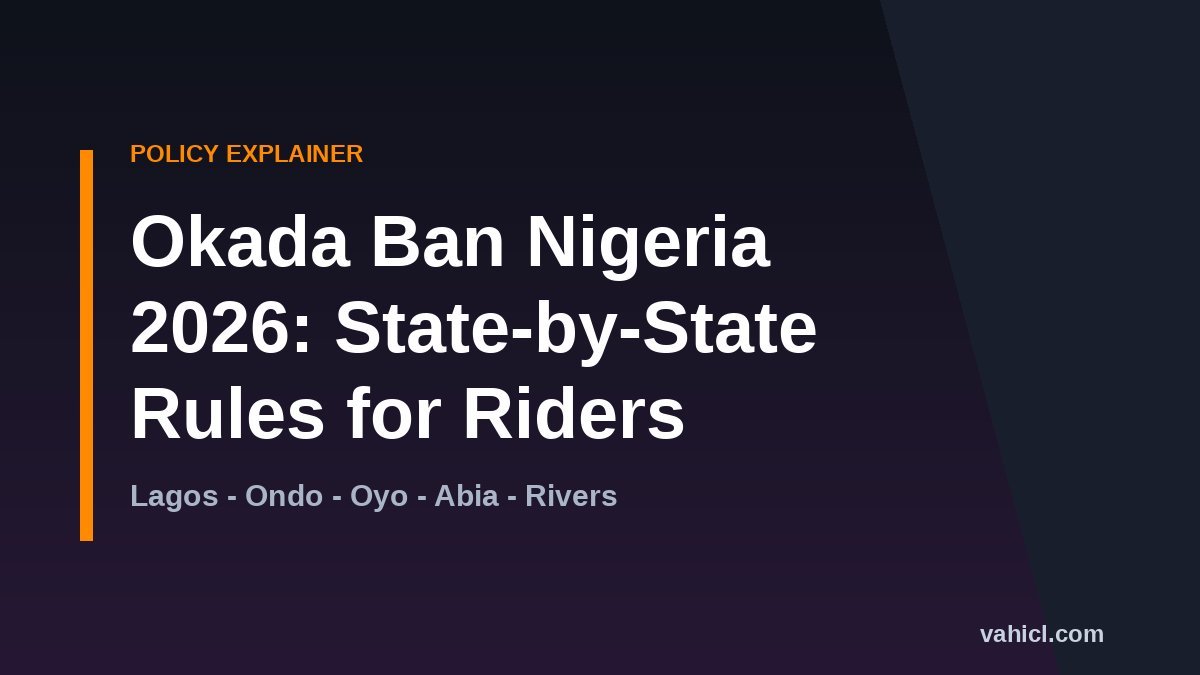
If you ride okada for a living in Nigeria, 2026 has been a year of moving goalposts. Lagos is still enforcing its ban in ten local government areas, the Federal Ministry of Works has pushed commercial motorcycles and tricycles off the Lagos–Calabar Coastal Highway and Lagos bridges, and states from Ondo to Abia have added their own night curfews and city-centre restrictions. Meanwhile petrol is hovering around ₦1,266 to ₦1,325 per litre depending on where you buy, which changes the maths on every trip you take.
This guide pulls the current picture together: where you cannot ride, what enforcement actually looks like, what a bike costs to buy and run today, and the legal routes riders are using to keep earning. It is written for riders, for people thinking of buying a motorcycle to hustle with, and for anyone running a delivery fleet in Lagos, Abuja or Port Harcourt.
Where okada is banned in Nigeria right now
There is no single national okada ban. Nigeria regulates commercial motorcycles state by state, and in some cases local government by local government. That is exactly why riders get caught out — a route that is legal at one junction becomes an impoundment risk two streets later.
Lagos State
Lagos operates the strictest and most consistently enforced restrictions in the country. Commercial okada operations remain prohibited across ten Local Government Areas and fifteen Local Council Development Areas. The banned LGAs are:
- Kosofe
- Oshodi-Isolo
- Somolu
- Mushin
- Apapa
- Ikeja
- Lagos Island
- Lagos Mainland
- Surulere
- Eti-Osa
Those ten cover most of the commercial heart of Lagos, which is precisely the problem for riders — the highest-earning corridors are the restricted ones. Enforcement is carried out by the state Ministry of Transportation working with the state task force, and it takes the form of periodic raids rather than continuous policing. Earlier in 2026 the Lagos Commissioner for Transportation confirmed the confiscation of 65 commercial motorcycles in a single Ikoyi enforcement sweep.
In early September 2026 the Rule of Law and Accountability Advocacy Centre called on the Lagos State House of Assembly to hold a public hearing on how the restrictions are being enforced, citing allegations of abuse and violent confrontations during raids. Whether that hearing happens matters to riders, because the current pattern — raid, impound, quiet return — leaves everyone guessing.
The federal bridge and coastal highway ban
This is the newest layer and the one most riders underestimate. The Federal Ministry of Works has banned commercial motorcycles and tricycles from the Lagos–Calabar Coastal Highway and from all bridges across Lagos State, on the stated grounds of protecting the new road surface and reducing accidents.
Because it is a federal restriction on federal infrastructure, it applies regardless of which LGA either end of the bridge sits in. A rider operating in a technically unrestricted LGA can still be stopped for crossing a bridge to get there.
Other states
- Ondo State — commercial motorcycle operation banned between 7pm and 6am, introduced as a security measure.
- Oyo State — a night-time restriction plus a QR code identification scheme for commercial riders, so enforcement officers can verify a rider on the spot.
- Abia State — restrictions covering the metropolitan areas of Umuahia, Aba and Ohafia, with okada banned inside those designated urban zones.
- Rivers State — at least one local government area introduced a commercial motorcycle ban taking effect from 1 August 2026.
The direction of travel is consistent: states are mostly not banning okada outright statewide, they are carving out city centres, highways and night hours. For a rider, that means your legal operating map is shrinking in exactly the places and at exactly the times where fares are highest.
What it costs to get on a bike in 2026
Motorcycle pricing in Nigeria moves with the exchange rate and with clearing costs, so treat everything below as a working range rather than a quote. Based on current dealer and marketplace listings:
- Grade-A used motorcycles — from around ₦450,000
- Bajaj models — roughly ₦550,000 to ₦1,200,000 depending on model and engine capacity
- New, higher-spec bikes generally — roughly ₦1,100,000 to ₦2,500,000
Bajaj remains the default workhorse for commercial riding because parts are everywhere and almost any roadside mechanic knows the engine. TVS has gained ground in 2026 with delivery fleets, particularly the HLX, which riders favour for being lighter and easier to thread through Lagos traffic than a loaded-up commuter bike.
Spare-parts availability should weigh heavily in your decision. A cheaper bike from a brand with thin distribution will cost you more in downtime than you saved at purchase — and downtime, not fuel, is what quietly kills rider income.
The running-cost maths at today’s petrol price
As of 10 September 2026, Dangote Petroleum Refinery’s pump price was ₦1,266 per litre, while retail stations in Lagos and Abuja were still selling as high as ₦1,325 per litre. Depot prices in Lagos sat between ₦1,266 and ₦1,280 per litre. That retail-versus-depot gap is transport, station margin and logistics, and it varies by location, so your local price may differ.
What that means practically: fuel is now a serious line item rather than an afterthought. Before you take a bike on hire-purchase, work out your daily fuel burn at roughly ₦1,300 per litre rather than at whatever you were paying last year. Many riders are still budgeting on stale numbers.
The other costs riders systematically underestimate:
- Impoundment risk. One confiscated bike can wipe out months of profit, and recovery is neither cheap nor guaranteed.
- Maintenance. Commercial mileage on Nigerian roads burns through chains, tyres, brake pads and suspension on a far shorter cycle than private use.
- Daily returns to the bike owner if you are riding someone else’s machine — fixed whether you had a good day or a raid day.
- Insurance and papers. Riding without valid third-party cover and correct registration turns any routine stop into a much more expensive one.
Delivery riding versus passenger okada
The clearest trend in 2026 is riders shifting from passenger okada into logistics and food delivery. The reason is regulatory as much as financial: restrictions are aimed primarily at commercial passenger carriage, and dispatch riding on a properly registered bike sits in a different, less-targeted category in most states — though it does not exempt you from the bridge and highway rules, or from night curfews where they exist.
On the numbers, one busy delivery bike running 10 to 15 drops a day has been reported to gross in the region of ₦300,000 to ₦600,000 a month. That is gross, not profit. Rider wages on those setups typically land around ₦70,000 to ₦150,000 monthly once fuel, maintenance and other operating costs come out. Anyone selling you a delivery-fleet business plan that quotes the gross figure as take-home is selling you something.
How riders are staying legal
- Learn your LGA boundaries properly. In Lagos the ban is defined by local government, not by how busy the road feels. Knowing exactly where a restricted LGA ends is worth real money.
- Avoid bridges in Lagos entirely on a commercial bike. The federal restriction does not care about your state-level status.
- Register for state schemes where they exist. Oyo’s QR code identification is friction at first, but it is also proof of legitimacy at a checkpoint.
- Respect night curfews. Ondo’s 7pm to 6am window and similar restrictions elsewhere are security-driven and enforced more seriously than daytime rules.
- Keep papers, helmet and valid insurance on you. FRSC and state task force stops go very differently when your documents are complete.
- Consider electric. Battery-swap and electric bike operators have expanded in Nigerian cities, and while the same restrictions apply, the per-kilometre running cost is a different conversation at ₦1,300 petrol.
Key takeaways
- There is no national okada ban — rules are set state by state and, in Lagos, LGA by LGA.
- Lagos bans commercial okada in 10 LGAs and 15 LCDAs, covering most of the high-earning central corridors.
- A separate federal ban keeps commercial motorcycles and tricycles off the Lagos–Calabar Coastal Highway and all Lagos bridges.
- Ondo, Oyo, Abia and parts of Rivers have added night curfews, urban-zone bans or rider identification schemes in 2026.
- Petrol around ₦1,266–₦1,325 per litre means your old daily fuel budget is almost certainly wrong.
- Delivery riding is where the growth is, but gross revenue and rider take-home are very different numbers.
Frequently asked questions
Can I still ride okada in Lagos in 2026?
Yes, in the areas not covered by the restrictions — but not in the ten banned LGAs or fifteen LCDAs, and not on bridges or the Lagos–Calabar Coastal Highway. Enforcement comes as periodic task force raids, so an absence of officers on a given day is not permission.
What happens if my bike is impounded?
Impounded motorcycles are seized by the state task force during enforcement operations. Recovery processes vary by state and are not guaranteed, which is why the cost of one raid usually exceeds whatever a restricted route earned you.
Is delivery riding covered by the okada ban?
Restrictions are generally targeted at commercial passenger carriage, which is why many riders have moved into dispatch work. But road-specific rules — bridges, the coastal highway — and night curfews still apply. Confirm the position with your state transport authority rather than assuming.
Which motorcycle is best for commercial riding in Nigeria?
Bajaj remains the most popular for general commercial use because parts and mechanics are available nationwide. TVS, particularly the HLX, has become a 2026 favourite among e-commerce and food delivery operators in Lagos and Abuja for its lighter handling in traffic.
Vehicle prices, import duties, fuel prices and state regulations change frequently in Nigeria — always confirm current figures and the rules in your own state with the dealer, your state transport authority or the relevant official source before buying or riding.
Reporting in this article draws on statements from the Federal Ministry of Works, the Lagos State Ministry of Transportation, state government announcements in Ondo, Oyo, Abia and Rivers, and September 2026 Nigerian fuel price reporting.




1 thought on “Okada Ban Nigeria 2026: State-by-State Rules for Riders”